Application
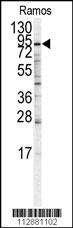
Western blot analysis of anti-NFATC2 Antibody (S330) in Ramos cell line lysates (35ug/lane). NFATC2 (arrow) was detected using the purified Pab.| Product Name | NFATC2 Antibody (S330) |
|---|---|
| Antibody Type | Primary Antibodies |
| Antigen Alias | NFATC2; NFAT1; NFATP; Nuclear factor of activated T-cells, cytoplasmic 2; NFAT pre-existing subunit; T-cell transcription factor NFAT1 |
| Clonality | Polyclonal |
|---|---|
| Isotype | Ig |
| Host Species | Rabbit |
| Tested Applications | WB |
| WB:1:50~100 |
|
| Species Reactivity | Human |
| Concentration | 1mg/ml |
| Gene Synonyms | NFAT1 NFATP |
|---|---|
| Alternative Names | NFATC2 NFAT1 NFATP Nuclear factor of activated T-cells cytoplasmic 2 NFAT pre-existing subunit T-cell transcription factor NFAT1 |
| Molecular Weight(MW) | 100146 Da |
| Function | Plays a role in the inducible expression of cytokine genes in T-cells, especially in the induction of the IL-2, IL-3, IL-4, TNF-alpha or GM-CSF. Promotes invasive migration through the activation of GPC6 expression and WNT5A signaling pathway |
| Tissue Specificity | Expressed in thymus, spleen, heart, testis, brain, placenta, muscle and pancreas. Isoform 1 is highly expressed in the small intestine, heart, testis, prostate, thymus, placenta and thyroid. Isoform 3 is highly expressed in stomach, uterus, placenta, trachea and thyroid |
| Cellular Localization | Cytoplasm. Nucleus. Note=Cytoplasmic for the phosphorylated form and nuclear after activation that is controlled by calcineurin-mediated dephosphorylation. Rapid nuclear exit of NFATC is thought to be one mechanism by which cells distinguish between sustained and transient calcium signals The subcellular localization of NFATC plays a key role in the regulation of gene transcription |
Application
Western blot analysis of anti-NFATC2 Antibody (S330) in Ramos cell line lysates (35ug/lane). NFATC2 (arrow) was detected using the purified Pab.| Application Notes | WB:1:50~100 |
|---|
| Form | Liquid |
|---|---|
| Storage Instructions | For short-term storage, store at 4° C. For long-term storage, aliquot and store at -20ºC or below. Avoid multiple freeze-thaw cycles. |
| Storage Buffer | Purified polyclonal antibody supplied in PBS with 0.09% (W/V) sodium azide. This antibody is purified through a protein A column, followed by peptide affinity purification. |


