Application
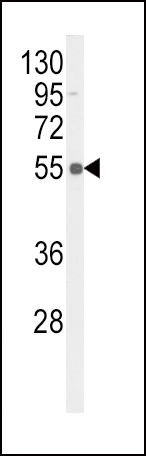
Western blot analysis of hTNFR-pS274 in MDA-MB468 cell line lysates (35ug/lane). TNFR (arrow) was detected using the purified Pab.| Product Name | Phospho-TNFR-S274 Antibody |
|---|---|
| Antibody Type | Primary Antibodies |
| Antigen Alias | Tumor necrosis factor receptor superfamily member 1A [Precursor]; p60; TNF-R1; TNF-RI; TNFR-I; p55; CD120a antigen; TNFRSF1A; TNFAR; TNFR1; |
| Modification | p-S274 |
| Clonality | Polyclonal |
|---|---|
| Isotype | Ig |
| Host Species | Rabbit |
| Tested Applications | WB |
| WB:1:100~500 |
|
| Species Reactivity | Human |
| Concentration | 1mg/ml |
| Gene Synonyms | TNFAR TNFR1 |
|---|---|
| Alternative Names | Tumor necrosis factor receptor superfamily member 1A [Precursor] p60 TNF-R1 TNF-RI TNFR-I p55 CD120a antigen TNFRSF1A TNFAR TNFR1 |
| Molecular Weight(MW) | 50495 Da |
| Function | Receptor for TNFSF2/TNF-alpha and homotrimeric TNFSF1/lymphotoxin-alpha. The adapter molecule FADD recruits caspase-8 to the activated receptor. The resulting death-inducing signaling complex (DISC) performs caspase-8 proteolytic activation which initiates the subsequent cascade of caspases (aspartate- specific cysteine proteases) mediating apoptosis. Contributes to the induction of non-cytocidal TNF effects including anti-viral state and activation of the acid sphingomyelinase |
| Tissue Specificity | This Phospho-TNFR-S274 antibody is generated from rabbits immunized with a KLH conjugated synthetic phosphopeptide corresponding to amino acid residues surrounding S274 of human TNFR. |
| Cellular Localization | Cell membrane; Single-pass type I membrane protein. Golgi apparatus membrane; Single-pass type I membrane protein. Secreted. Note=A secreted form is produced through proteolytic processing |
| Entrez Gene | 7132 |
|---|
Application
Western blot analysis of hTNFR-pS274 in MDA-MB468 cell line lysates (35ug/lane). TNFR (arrow) was detected using the purified Pab.| Application Notes | WB:1:100~500 |
|---|
| Form | Liquid |
|---|---|
| Storage Instructions | For short-term storage, store at 4° C. For long-term storage, aliquot and store at -20ºC or below. Avoid multiple freeze-thaw cycles. |
| Storage Buffer | Purified polyclonal antibody supplied in PBS with 0.09% (W/V) sodium azide. This antibody is first purified by protein G affinity chromatography. Then, the antibody fraction is peptide affinity purified in a 2-step procedure with control and phosphorylated peptides. The phospho-specific antibody is eluted with high and low pH buffers and neutralized immediately, followed by dialysis against PBS. |


