Application
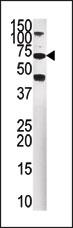
Western blot analysis of anti-PSN1 Pab in mouse kidney tissue lysate (35ug/lane). PSN1(arrow) was detected using the purified Pab (1:60 dilution).| Product Name | Presenilin 1 (PSEN1) Antibody (Center) |
|---|---|
| Antibody Type | Primary Antibodies |
| Antigen Alias | PSEN1; AD3; PS1; PSNL1; Presenilin-1; Protein S182; Presenilin-1 NTF subunit; Presenilin-1 CTF subunit; Presenilin-1 CTF12 |
| Clonality | Polyclonal |
|---|---|
| Isotype | Ig |
| Host Species | Rabbit |
| Tested Applications | WB |
| WB:1:100~500 |
|
| Species Reactivity | Human |
| Concentration | 1mg/ml |
| Gene Synonyms | AD3 PS1 PSNL1 |
|---|---|
| Alternative Names | PSEN1 AD3 PS1 PSNL1 Presenilin-1 Protein S182 Presenilin-1 NTF subunit Presenilin-1 CTF subunit Presenilin-1 CTF12 |
| Molecular Weight(MW) | 52668 Da |
| Function | Probable catalytic subunit of the gamma-secretase complex, an endoprotease complex that catalyzes the intramembrane cleavage of integral membrane proteins such as Notch receptors and APP (beta-amyloid precursor protein). Requires the other members of the gamma-secretase complex to have a protease activity. May play a role in intracellular signaling and gene expression or in linking chromatin to the nuclear membrane. Stimulates cell-cell adhesion though its association with the E-cadherin/catenin complex. Under conditions of apoptosis or calcium influx, cleaves E-cadherin promoting the disassembly of the E-cadherin/catenin complex and increasing the pool of cytoplasmic beta-catenin, thus negatively regulating Wnt signaling. May also play a role in hematopoiesis |
| Tissue Specificity | Expressed in a wide range of tissues including various regions of the brain, liver, spleen and lymph nodes |
| Cellular Localization | Endoplasmic reticulum membrane; Multi-pass membrane protein. Golgi apparatus membrane; Multi-pass membrane protein. Cell surface. Note=Bound to NOTCH1 also at the cell surface. Colocalizes with CDH1/2 at sites of cell-cell contact Colocalizes with CTNNB1 in the endoplasmic reticulum and the proximity of the plasma membrane. Also present in azurophil granules of neutrophils |
| Entrez Gene | 5663 |
|---|
Application
Western blot analysis of anti-PSN1 Pab in mouse kidney tissue lysate (35ug/lane). PSN1(arrow) was detected using the purified Pab (1:60 dilution).| Application Notes | WB:1:100~500 |
|---|
| Form | Liquid |
|---|---|
| Storage Instructions | For short-term storage, store at 4° C. For long-term storage, aliquot and store at -20ºC or below. Avoid multiple freeze-thaw cycles. |
| Storage Buffer | Purified polyclonal antibody supplied in PBS with 0.09% (W/V) sodium azide. This antibody is purified through a protein G column, eluted with high and low pH buffers and neutralized immediately, followed by dialysis against PBS. |


