Application
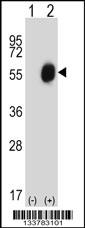
Western blot analysis of RARA (arrow) using rabbit polyclonal RARA Antibody (C-term) . 293 cell lysates (2 ug/lane) either nontransfected (Lane 1) or transiently transfected (Lane 2) with the RARA gene.Application
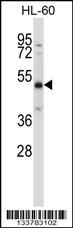
RARA Antibody (C-term) western blot analysis in HL-60 cell line lysates (35ug/lane).This demonstrates the RARA antibody detected the RARA protein (arrow).Application
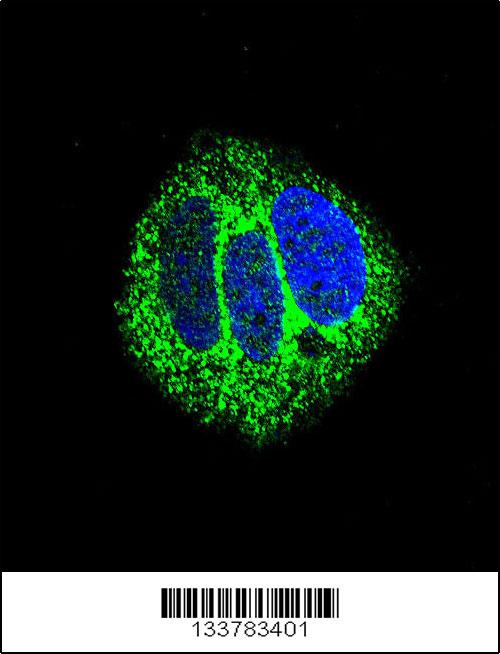
Confocal immunofluorescent analysis of RARA Antibody (C-term) (Cat#AP13849b) with MCF-7 cell followed by Alexa Fluor® 488-conjugated goat anti-rabbit lgG (green). DAPI was used to stain the cell nuclear (blue).Application
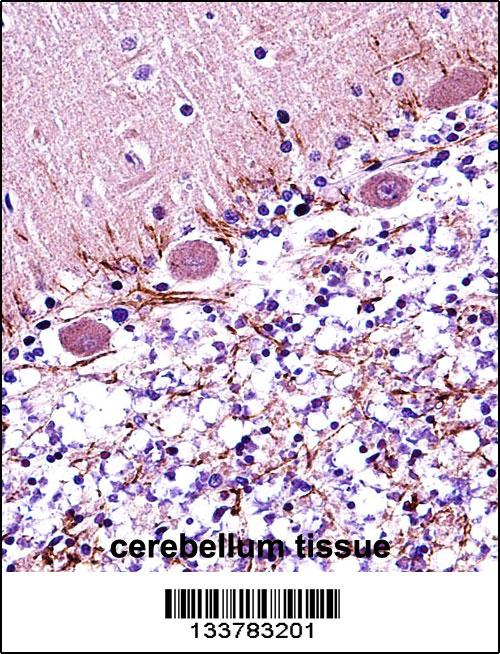
RARA Antibody (C-term) immunohistochemistry analysis in formalin fixed and paraffin embedded human cerebellum tissue followed by peroxidase conjugation of the secondary antibody and DAB staining.This data demonstrates the use of RARA Antibody (C-term) for immunohistochemistry. Clinical relevance has not been evaluated.Application
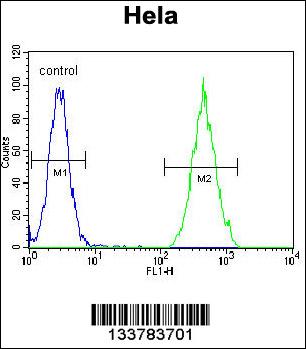
RARA Antibody (C-term) flow cytometric analysis of Hela cells (right histogram) compared to a negative control cell (left histogram).FITC-conjugated goat-anti-rabbit secondary antibodies were used for the analysis.| Product Name | RARA Antibody (C-term) |
|---|---|
| Antibody Type | Primary Antibodies |
| Antigen Alias | RARA; NR1B1; Retinoic acid receptor alpha; Nuclear receptor subfamily 1 group B member 1 |
| Clonality | Polyclonal |
|---|---|
| Isotype | Ig |
| Host Species | Rabbit |
| Tested Applications | WBIFIHCFC |
| WB:1:100~500 IF |
|
| Species Reactivity | Human |
| Concentration | 1mg/ml |
| Gene Synonyms | NR1B1 |
|---|---|
| Alternative Names | RARA NR1B1 Retinoic acid receptor alpha Nuclear receptor subfamily 1 group B member 1 |
| Molecular Weight(MW) | 50771 Da |
| Function | Receptor for retinoic acid. Retinoic acid receptors bind as heterodimers to their target response elements in response to their ligands, all-trans or 9-cis retinoic acid, and regulate gene expression in various biological processes. The RXR/RAR heterodimers bind to the retinoic acid response elements (RARE) composed of tandem 5'-AGGTCA-3' sites known as DR1-DR5. In the absence of ligand, the RXR-RAR heterodimers associate with a multiprotein complex containing transcription corepressors that induce histone acetylation, chromatin condensation and transcriptional suppression. On ligand binding, the corepressors dissociate from the receptors and associate with the coactivators leading to transcriptional activation. RARA plays an essential role in the regulation of retinoic acid-induced germ cell development during spermatogenesis. Has a role in the survival of early spermatocytes at the beginning prophase of meiosis. In Sertoli cells, may promote the survival and development of early meiotic prophase spermatocytes. In concert with RARG, required for skeletal growth, matrix homeostasis and growth plate function (By similarity). Regulates expression of target genes in a ligand- dependent manner by recruiting chromatin complexes containing MLL5. Mediates retinoic acid-induced granulopoiesis |
| Tissue Specificity | This RARA antibody is generated from rabbits immunized with a KLH conjugated synthetic peptide between 321-379 amino acids from the C-terminal region of human RARA. |
| Cellular Localization | Nucleus. Cytoplasm. Note=Nuclear localization depends on ligand binding, phosphorylation and sumoylation. Transloaction to the nucleus in the absence of ligand is dependent on activation of PKC and the downstream MAPK phosphorylation |
| Entrez Gene | 5914 |
|---|---|
| Nucleotide Accession | NP_000955.1 |
Application
Western blot analysis of RARA (arrow) using rabbit polyclonal RARA Antibody (C-term) . 293 cell lysates (2 ug/lane) either nontransfected (Lane 1) or transiently transfected (Lane 2) with the RARA gene.
Application
RARA Antibody (C-term) western blot analysis in HL-60 cell line lysates (35ug/lane).This demonstrates the RARA antibody detected the RARA protein (arrow).
Application
Confocal immunofluorescent analysis of RARA Antibody (C-term) (Cat#AP13849b) with MCF-7 cell followed by Alexa Fluor® 488-conjugated goat anti-rabbit lgG (green). DAPI was used to stain the cell nuclear (blue).
Application
RARA Antibody (C-term) immunohistochemistry analysis in formalin fixed and paraffin embedded human cerebellum tissue followed by peroxidase conjugation of the secondary antibody and DAB staining.This data demonstrates the use of RARA Antibody (C-term) for immunohistochemistry. Clinical relevance has not been evaluated.
Application
RARA Antibody (C-term) flow cytometric analysis of Hela cells (right histogram) compared to a negative control cell (left histogram).FITC-conjugated goat-anti-rabbit secondary antibodies were used for the analysis.| Application Notes | WB:1:100~500 IF |
|---|
| Form | Liquid |
|---|---|
| Storage Instructions | For short-term storage, store at 4° C. For long-term storage, aliquot and store at -20ºC or below. Avoid multiple freeze-thaw cycles. |
| Storage Buffer | Purified polyclonal antibody supplied in PBS with 0.09% (W/V) sodium azide. This antibody is purified through a protein A column, followed by peptide affinity purification. |


