Application
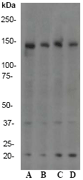
A. Western blot analysis of anti-Raptor RabMAb (Cat. #AJ1679a), dilution 1:500. A: 293 B: MCF-7 C: Hela D: A431.Application
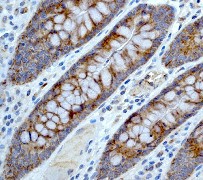
B. Immunohistochemical analysis of paraffin-embedded human colon using anti-Raptor RabMAb (Cat. #AJ1679a).| Product Name | Raptor Antibody |
|---|---|
| Antibody Type | Primary Antibodies |
| Antigen Alias | RPTOR, KIAA1303, RAPTOR, Regulatory-associated protein of mTOR, P150 target of rapamycin (TOR)-scaffold protein |
| Clonality | Monoclonal |
|---|---|
| Clone Number | EP539Y |
| Host Species | Rabbit |
| Tested Applications | WBIHC |
| WB:1:1000 IHC |
|
| Species Reactivity | Human |
| Concentration | 1mg/ml |
| Gene Synonyms | KIAA1303 RAPTOR |
|---|---|
| Alternative Names | RPTOR KIAA1303 RAPTOR Regulatory-associated protein of mTOR P150 target of rapamycin (TOR)-scaffold protein |
| Molecular Weight(MW) | 149038 Da |
| Function | Involved in the control of the mammalian target of rapamycin complex 1 (mTORC1) activity which regulates cell growth and survival, and autophagy in response to nutrient and hormonal signals; functions as a scaffold for recruiting mTORC1 substrates mTORC1 is activated in response to growth factors or amino acids Growth factor-stimulated mTORC1 activation involves a AKT1- mediated phosphorylation of TSC1-TSC2, which leads to the activation of the RHEB GTPase that potently activates the protein kinase activity of mTORC1. Amino acid-signaling to mTORC1 requires its relocalization to the lysosomes mediated by the Ragulator complex and the Rag GTPases. Activated mTORC1 up-regulates protein synthesis by phosphorylating key regulators of mRNA translation and ribosome synthesis. mTORC1 phosphorylates EIF4EBP1 and releases it from inhibiting the elongation initiation factor 4E (eiF4E). mTORC1 phosphorylates and activates S6K1 at 'Thr-389', which then promotes protein synthesis by phosphorylating PDCD4 and targeting it for degradation |
| Tissue Specificity | Highly expressed in skeletal muscle, and in a lesser extent in brain, lung, small intestine, kidney and placenta |
| Cellular Localization | Cytoplasm. Lysosome. Note=Targeting to lysosomes depends on amino acid availability |
| Entrez Gene | 57521 |
|---|
Application
A. Western blot analysis of anti-Raptor RabMAb (Cat. #AJ1679a), dilution 1:500. A: 293 B: MCF-7 C: Hela D: A431.
Application
B. Immunohistochemical analysis of paraffin-embedded human colon using anti-Raptor RabMAb (Cat. #AJ1679a).| Application Notes | WB:1:1000 IHC |
|---|
| Form | Liquid |
|---|---|
| Storage Instructions | For short-term storage, store at 4° C. For long-term storage, aliquot and store at -20ºC or below. Avoid multiple freeze-thaw cycles. |
| Storage Buffer | 50 mM Tris-Glycine (pH 7.4), 0.15 M NaCl, 40% Glycerol, 0.01% sodium azide and 0.05% BSA. |


