Application
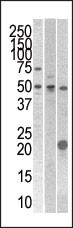
The anti- STYK1 Pab is used in Western blot to detect STYK1 in 293 , CEM (center), and mouse kidney cell line/tissue lysates.| Product Name | STYK1 Antibody (N-term) |
|---|---|
| Antibody Type | Primary Antibodies |
| Antigen Alias | STYK1; NOK; Tyrosine-protein kinase STYK1; Novel oncogene with kinase domain; Protein PK-unique; Serine/threonine/tyrosine kinase 1 |
| Clonality | Polyclonal |
|---|---|
| Isotype | Ig |
| Host Species | Rabbit |
| Tested Applications | WB |
| WB:1:250~500 |
|
| Species Reactivity | Human |
| Concentration | 1mg/ml |
| Gene Synonyms | NOK |
|---|---|
| Alternative Names | STYK1 NOK Tyrosine-protein kinase STYK1 Novel oncogene with kinase domain Protein PK-unique Serine/threonine/tyrosine kinase 1 |
| Molecular Weight(MW) | 47577 Da |
| Function | Probable tyrosine protein-kinase, which has strong transforming capabilities on a variety of cell lines. When overexpressed, it can also induce tumor cell invasion as well as metastasis in distant organs. May act by activating both MAP kinase and phosphatidylinositol 3'-kinases (PI3K) pathways (By similarity) |
| Tissue Specificity | Widely expressed. Highly expressed in brain, placenta and prostate. Expressed in tumor cells such as hepatoma cells L-02, cervix carcinoma cells HeLa, ovary cancer cells Ho8910 and chronic myelogenous leukemia cells K-562, but not in other tumor cells such as epidermoid carcinoma (A-431). Undetectable in most normal lung tissues, widely expressed in lung cancers |
| Cellular Localization | Membrane; Single-pass membrane protein (Potential) |
Application
The anti- STYK1 Pab is used in Western blot to detect STYK1 in 293 , CEM (center), and mouse kidney cell line/tissue lysates.| Application Notes | WB:1:250~500 |
|---|
| Form | Liquid |
|---|---|
| Storage Instructions | For short-term storage, store at 4° C. For long-term storage, aliquot and store at -20ºC or below. Avoid multiple freeze-thaw cycles. |
| Storage Buffer | Purified polyclonal antibody supplied in PBS with 0.09% (W/V) sodium azide. This antibody is purified through a protein G column, eluted with high and low pH buffers and neutralized immediately, followed by dialysis against PBS. |


