Application
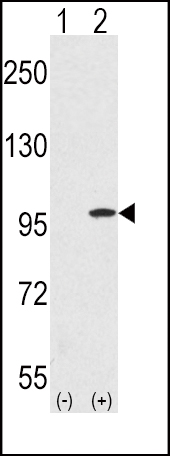
Western blot analysis of TERT(arrow) using TERT Antibody (S1125) . 293 cell lysates (2 ug/lane) either nontransfected (Lane 1) or transiently transfected with the TERT gene (Lane 2) (Origene Technologies).Application
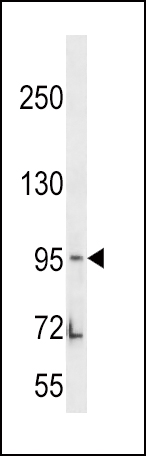
Western blot analysis of TERT Antibody (S1125) in Sk-Br-3 cell line lysates (35ug/lane). TERT (arrow) was detected using the purified Pab.Application
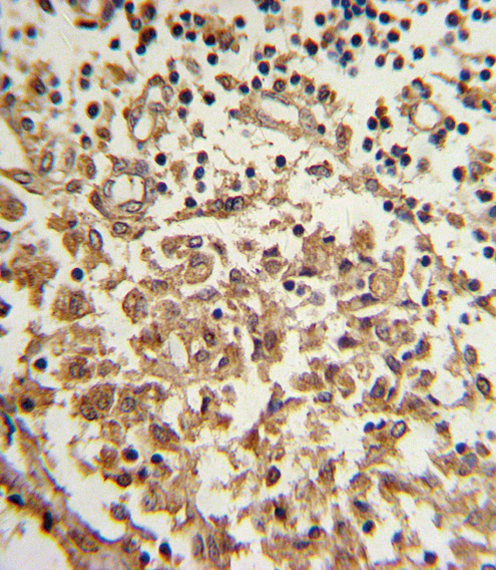
Formalin-fixed and paraffin-embedded human lymph with TERT Antibody (S1125), which was peroxidase-conjugated to the secondary antibody, followed by DAB staining. This data demonstrates the use of this antibody for immunohistochemistry; clinical relevance has not been evaluated.Application
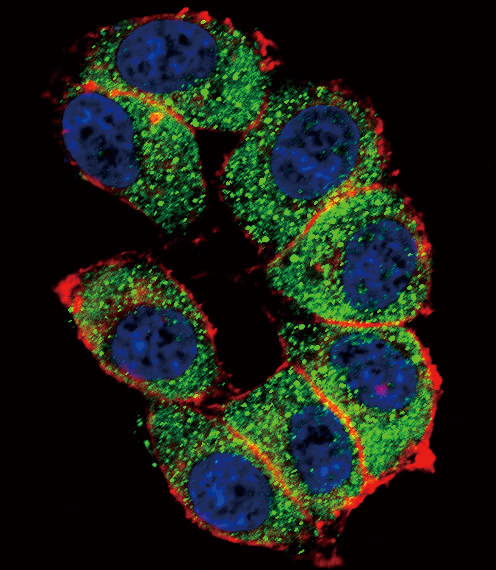
Confocal immunofluorescent analysis of TERT Antibody (S1125)(Cat#AP1410d) with Hela cell followed by Alexa Fluor 488-conjugated goat anti-rabbit lgG (green). Actin filaments have been labeled with Alexa Fluor 555 phalloidin (red).DAPI was used to stain the cell nuclear (blue).Application
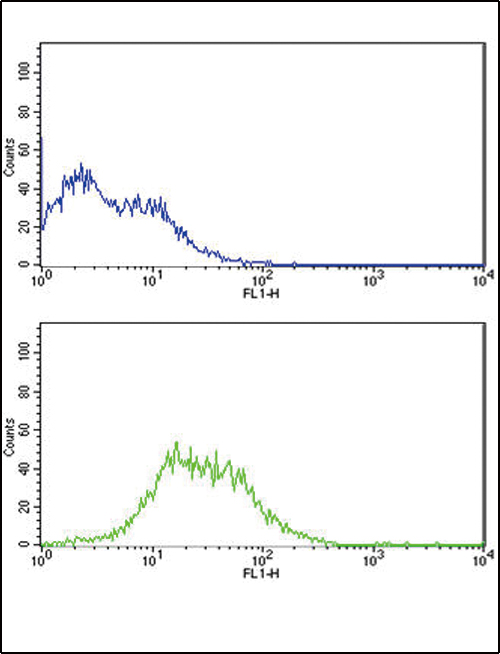
TERT Antibody (S1125) flow cytometric analysis of Jurkat cells (bottom histogram) compared to a negative control cell (top histogram).FITC-conjugated goat-anti-rabbit secondary antibodies were used for the analysis.| Product Name | TERT Antibody (S1125) |
|---|---|
| Antibody Type | Primary Antibodies |
| Clonality | Polyclonal |
|---|---|
| Isotype | Ig |
| Host Species | Rabbit |
| Tested Applications | WBIHCIFFC |
| WB:1:100~500 IHC |
|
| Species Reactivity | Human |
| Concentration | 1mg/ml |
| Gene Synonyms | EST2, TCS1, TRT |
|---|---|
| Alternative Names | TERT EST2 TCS1 TRT Telomerase reverse transcriptase HEST2 Telomerase catalytic subunit Telomerase-associated protein 2 |
| Molecular Weight(MW) | 126997 Da |
| Function | Telomerase is a ribonucleoprotein enzyme essential for the replication of chromosome termini in most eukaryotes. Active in progenitor and cancer cells. Inactive, or very low activity, in normal somatic cells. Catalytic component of the teleromerase holoenzyme complex whose main activity is the elongation of telomeres by acting as a reverse transcriptase that adds simple sequence repeats to chromosome ends by copying a template sequence within the RNA component of the enzyme. Catalyzes the RNA- dependent extension of 3'-chromosomal termini with the 6- nucleotide telomeric repeat unit, 5'-TTAGGG-3'. The catalytic cycle involves primer binding, primer extension and release of product once the template boundary has been reached or nascent product translocation followed by further extension. More active on substrates containing 2 or 3 telomeric repeats. Telomerase activity is regulated by a number of factors including telomerase complex-associated proteins, chaperones and polypeptide modifiers Modulates Wnt signaling. Plays important roles in aging and antiapoptosis |
| Tissue Specificity | Expressed at a high level in thymocyte subpopulations, at an intermediate level in tonsil T-lymphocytes, and at a low to undetectable level in peripheral blood T- lymphocytes |
| Cellular Localization | Nucleus, nucleolus. Nucleus, nucleoplasm. Nucleus. Chromosome, telomere. Cytoplasm. Nucleus, PML body Note=Shuttling between nuclear and cytoplasm depends on cell cycle, phosphorylation states, transformation and DNA damage Diffuse localization in the nucleoplasm. Enriched in nucleoli of certain cell types. Translocated to the cytoplasm via nuclear pores in a CRM1/RAN-dependent manner involving oxidative stress- mediated phosphorylation at Tyr-707. Dephosphorylation at this site by SHP2 retains TERT in the nucleus. Translocated to the nucleus by phosphorylation by AKT |
| Entrez Gene | 7015 |
|---|
Application
Western blot analysis of TERT(arrow) using TERT Antibody (S1125) . 293 cell lysates (2 ug/lane) either nontransfected (Lane 1) or transiently transfected with the TERT gene (Lane 2) (Origene Technologies).
Application
Western blot analysis of TERT Antibody (S1125) in Sk-Br-3 cell line lysates (35ug/lane). TERT (arrow) was detected using the purified Pab.
Application
Formalin-fixed and paraffin-embedded human lymph with TERT Antibody (S1125), which was peroxidase-conjugated to the secondary antibody, followed by DAB staining. This data demonstrates the use of this antibody for immunohistochemistry; clinical relevance has not been evaluated.
Application
Confocal immunofluorescent analysis of TERT Antibody (S1125)(Cat#AP1410d) with Hela cell followed by Alexa Fluor 488-conjugated goat anti-rabbit lgG (green). Actin filaments have been labeled with Alexa Fluor 555 phalloidin (red).DAPI was used to stain the cell nuclear (blue).
Application
TERT Antibody (S1125) flow cytometric analysis of Jurkat cells (bottom histogram) compared to a negative control cell (top histogram).FITC-conjugated goat-anti-rabbit secondary antibodies were used for the analysis.| Application Notes | WB:1:100~500 IHC |
|---|
| Form | Liquid |
|---|---|
| Storage Instructions | For short-term storage, store at 4° C. For long-term storage, aliquot and store at -20ºC or below. Avoid multiple freeze-thaw cycles. |
| Storage Buffer | Purified polyclonal antibody supplied in PBS with 0.09% (W/V) sodium azide. This antibody is purified through a protein A column, followed by peptide affinity purification. |


