Application
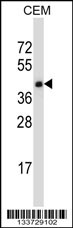
TNFRSF10D Antibody (C-term) western blot analysis in CEM cell line lysates (35ug/lane).This demonstrates the TNFRSF10D antibody detected the TNFRSF10D protein (arrow).| Product Name | TNFRSF10D Antibody (C-term) |
|---|---|
| Antibody Type | Primary Antibodies |
| Antigen Alias | TNFRSF10D; DCR2; TRAILR4; TRUNDD; Tumor necrosis factor receptor superfamily member 10D; Decoy receptor 2; TNF-related apoptosis-inducing ligand receptor 4; TRAIL receptor with a truncated death domain; CD_antigen=CD264; Flags: Precursor |
| Clonality | Polyclonal |
|---|---|
| Isotype | Ig |
| Host Species | Rabbit |
| Tested Applications | WB |
| WB:1:100~500 |
|
| Species Reactivity | Human |
| Concentration | 1mg/ml |
| Gene Synonyms | DCR2 TRAILR4 TRUNDD |
|---|---|
| Alternative Names | TNFRSF10D DCR2 TRAILR4 TRUNDD Tumor necrosis factor receptor superfamily member 10D Decoy receptor 2 TNF-related apoptosis-inducing ligand receptor 4 TRAIL receptor with a truncated death domain CD_antigen=CD264 Flags: Precursor |
| Molecular Weight(MW) | 41823 Da |
| Function | Receptor for the cytotoxic ligand TRAIL. Contains a truncated death domain and hence is not capable of inducing apoptosis but protects against TRAIL-mediated apoptosis. Reports are contradictory with regards to its ability to induce the NF- kappa-B pathway. According to PubMed:9382840, it cannot but according to PubMed:9430226, it can induce the NF-kappa-B pathway |
| Tissue Specificity | Widely expressed, in particular in fetal kidney, lung and liver, and in adult testis and liver. Also expressed in peripheral blood leukocytes, colon and small intestine, ovary, prostate, thymus, spleen, pancreas, kidney, lung, placenta and heart |
| Cellular Localization | Membrane; Single-pass type I membrane protein |
| Entrez Gene | 8793 |
|---|---|
| Nucleotide Accession | NP_003831.2 |
Application
TNFRSF10D Antibody (C-term) western blot analysis in CEM cell line lysates (35ug/lane).This demonstrates the TNFRSF10D antibody detected the TNFRSF10D protein (arrow).| Application Notes | WB:1:100~500 |
|---|
| Form | Liquid |
|---|---|
| Storage Instructions | For short-term storage, store at 4° C. For long-term storage, aliquot and store at -20ºC or below. Avoid multiple freeze-thaw cycles. |
| Storage Buffer | Purified polyclonal antibody supplied in PBS with 0.09% (W/V) sodium azide. This antibody is purified through a protein A column, followed by peptide affinity purification. |


