Application
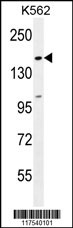
ANAPC1 Antibody (N-term) western blot analysis in K562 cell line lysates (35ug/lane).This demonstrates the ANAPC1 antibody detected the ANAPC1 protein (arrow).| Product Name | ANAPC1 Antibody (N-term) |
|---|---|
| Antibody Type | Primary Antibodies |
| Antigen Alias | ANAPC1; TSG24; Anaphase-promoting complex subunit 1; Cyclosome subunit 1; Mitotic checkpoint regulator; Testis-specific gene 24 protein |
| Clonality | Polyclonal |
|---|---|
| Isotype | Ig |
| Host Species | Rabbit |
| Tested Applications | WB |
| WB:1:100~500 |
|
| Species Reactivity | Human |
| Concentration | 1mg/ml |
| Gene Synonyms | TSG24 |
|---|---|
| Alternative Names | ANAPC1 TSG24 Anaphase-promoting complex subunit 1 Cyclosome subunit 1 Mitotic checkpoint regulator Testis-specific gene 24 protein |
| Molecular Weight(MW) | 216500 Da |
| Function | Component of the anaphase promoting complex/cyclosome (APC/C), a cell cycle-regulated E3 ubiquitin ligase that controls progression through mitosis and the G1 phase of the cell cycle The APC/C complex acts by mediating ubiquitination and subsequent degradation of target proteins: it mainly mediates the formation of 'Lys-11'-linked polyubiquitin chains and, to a lower extent, the formation of 'Lys-48'- and 'Lys-63'-linked polyubiquitin chains |
| Tissue Specificity | This ANAPC1 antibody is generated from rabbits immunized with a KLH conjugated synthetic peptide between 7-36 amino acids from the N-terminal region of human ANAPC1. |
| Entrez Gene | 64682 |
|---|---|
| Nucleotide Accession | NP_073153.1 |
Application
ANAPC1 Antibody (N-term) western blot analysis in K562 cell line lysates (35ug/lane).This demonstrates the ANAPC1 antibody detected the ANAPC1 protein (arrow).| Application Notes | WB:1:100~500 |
|---|
| Form | Liquid |
|---|---|
| Storage Instructions | For short-term storage, store at 4° C. For long-term storage, aliquot and store at -20ºC or below. Avoid multiple freeze-thaw cycles. |
| Storage Buffer | Purified polyclonal antibody supplied in PBS with 0.09% (W/V) sodium azide. This antibody is purified through a protein A column, followed by peptide affinity purification. |


