Application
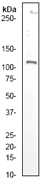
A. Western blot analysis on Jurkat cell lysates using anti-Cbl (C-term) RabMAb (Cat. #AJ1142b), 1:5,000 dilution.Application
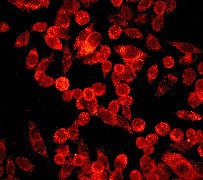
B. Immunofluorescent staining of HeLa cells using anti-Cbl (C-term) RabMAb (Cat. #AJ1142b).| Product Name | Cbl Antibody (C-term) |
|---|---|
| Antibody Type | Primary Antibodies |
| Antigen Alias | CBL, CBL2, RNF55, E3 ubiquitin-protein ligase CBL, Signal transduction protein CBL;Proto-oncogene c-CBL;Casitas B-lineage lymphoma proto-oncogene;RING finger protein 55 |
| Clonality | Monoclonal |
|---|---|
| Clone Number | YE323 |
| Host Species | Rabbit |
| Tested Applications | WBIF |
| WB:1:100000~200000 |
|
| Species Reactivity | Human |
| Concentration | 1mg/ml |
| Gene Synonyms | CBL2 RNF55 |
|---|---|
| Alternative Names | CBL CBL2 RNF55 E3 ubiquitin-protein ligase CBL Signal transduction protein CBL Proto-oncogene c-CBL Casitas B-lineage lymphoma proto-oncogene RING finger protein 55 |
| Molecular Weight(MW) | 99633 Da |
| Function | Adapter protein that functions as a negative regulator of many signaling pathways that are triggered by activation of cell surface receptors. Acts as an E3 ubiquitin-protein ligase, which accepts ubiquitin from specific E2 ubiquitin-conjugating enzymes, and then transfers it to substrates promoting their degradation by the proteasome. Recognizes activated receptor tyrosine kinases, including KIT, FLT1, FGFR1, FGFR2, PDGFRA, PDGFRB, EGFR, CSF1R, EPHA8 and KDR and terminates signaling Recognizes membrane-bound HCK and other kinases of the SRC family and mediates their ubiquitination and degradation. Participates in signal transduction in hematopoietic cells. Plays an important role in the regulation of osteoblast differentiation and apoptosis. Essential for osteoclastic bone resorption. The Tyr-731 phosphorylated form induces the activation and recruitment of phosphatidylinositol 3-kinase to the cell membrane in a signaling pathway that is critical for osteoclast function |
| Tissue Specificity | A synthetic peptide corresponding to residues in C-terminus of human Cbl was used as immunogen. Predicted to cross-react with chicken, based on sequence homology. |
| Cellular Localization | Cytoplasm. Cell membrane. Note=Colocalizes with FGFR2 in lipid rafts at the cell membrane |
| Entrez Gene | 867 |
|---|
Application
A. Western blot analysis on Jurkat cell lysates using anti-Cbl (C-term) RabMAb (Cat. #AJ1142b), 1:5,000 dilution.
Application
B. Immunofluorescent staining of HeLa cells using anti-Cbl (C-term) RabMAb (Cat. #AJ1142b).| Application Notes | WB:1:100000~200000 |
|---|
| Form | Liquid |
|---|---|
| Storage Instructions | For short-term storage, store at 4° C. For long-term storage, aliquot and store at -20ºC or below. Avoid multiple freeze-thaw cycles. |
| Storage Buffer | 50 mM Tris-Glycine (pH 7.4), 0.15 M NaCl, 40% Glycerol, 0.01% sodium azide and 0.05% BSA. |


