Application
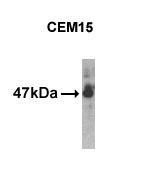
Western analysis of cell lysates from PBMC cells using CEM15 abtibody.| Product Name | CEM15 Antibody |
|---|---|
| Antibody Type | Primary Antibodies |
| Antigen Alias | APOBEC3G; DNA dC->dU-editing enzyme APOBEC-3G; APOBEC-related cytidine deaminase; APOBEC-related protein 9; CEM-15; Deoxycytidine deaminase |
| Clonality | Monoclonal |
|---|---|
| Isotype | IgG1 |
| Clone Number | 34AT1147 |
| Host Species | Mouse |
| Tested Applications | WB |
| WB:1:100~500 |
|
| Species Reactivity | Human |
| Concentration | 1mg/ml |
| Alternative Names | APOBEC3G DNA dC->dU-editing enzyme APOBEC-3G APOBEC-related cytidine deaminase APOBEC-related protein 9 CEM-15 Deoxycytidine deaminase |
|---|---|
| Molecular Weight(MW) | 46408 Da |
| Function | DNA deaminase (cytidine deaminase) which acts as an inhibitor of retrovirus replication and retrotransposon mobility via deaminase-dependent and -independent mechanisms. Exhibits potent antiviral activity against vif-deficient HIV-1. After the penetration of retroviral nucleocapsids into target cells of infection and the initiation of reverse transcription, it can induce the conversion of cytosine to uracil in the minus-sense single-strand viral DNA, leading to G-to-A hypermutations in the subsequent plus-strand viral DNA. The resultant detrimental levels of mutations in the proviral genome, along with a deamination- independent mechanism that works prior to the proviral integration, together exert efficient antiretroviral effects in infected target cells. Selectively targets single-stranded DNA and does not deaminate double-stranded DNA or single-or double- stranded RNA. Exhibits antiviral activity also against simian immunodeficiency viruses (SIVs), hepatitis B virus (HBV), equine infectious anemia virus (EIAV), xenotropic MuLV-related virus (XMRV) and simian foamy virus (SFV). May inhibit the mobility of LTR and non-LTR retrotransposons |
| Tissue Specificity | Expressed in spleen, testes, ovary and peripheral blood leukocytes and CD4+ lymphocytes. Also expressed in non-permissive peripheral blood mononuclear cells, and several tumor cell lines; no expression detected in permissive lymphoid and non-lymphoid cell lines. Exists only in the LMM form in peripheral blood-derived resting CD4 T-cells and monocytes, both of which are refractory to HIV-1 infection. LMM is converted to a HMM complex when resting CD4 T cells are activated or when monocytes are induced to differentiate into macrophages. This change correlates with increased susceptibility of these cells to HIV-1 infection |
| Cellular Localization | Cytoplasm. Nucleus. Cytoplasm, P-body. Note=Mainly cytoplasmic. Small amount are found in the nucleus During HIV-1 infection, virion-encapsidated in absence of HIV-1 VIF |
| Entrez Gene | 60489 |
|---|
Application
Western analysis of cell lysates from PBMC cells using CEM15 abtibody.| Application Notes | WB:1:100~500 |
|---|
| Form | Liquid |
|---|---|
| Storage Instructions | For short-term storage, store at 4° C. For long-term storage, aliquot and store at -20ºC or below. Avoid multiple freeze-thaw cycles. |
| Storage Buffer | Purified monoclonal antibody supplied in PBS with 0.09% (W/V) sodium azide. This antibody is purified through a protein G column, eluted with high and low pH buffers and neutralized immediately, followed by dialysis against PBS. |


