Application
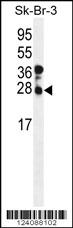
Western blot analysis of CHMP4B Antibody (N-term) in SK-BR-3 cell line lysates (35ug/lane).CHMP4B (arrow) was detected using the purified Pab.Application
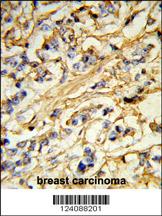
Formalin-fixed and paraffin-embedded human breast carcinoma reacted with CHMP4B Antibody (N-term), which was peroxidase-conjugated to the secondary antibody, followed by DAB staining. This data demonstrates the use of this antibody for immunohistochemistry; clinical relevance has not been evaluated.Application
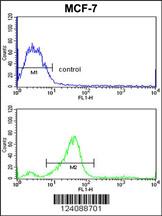
CHMP4B Antibody (N-term) flow cytometric analysis of MCF-7 cells (bottom histogram) compared to a negative control cell (top histogram).FITC-conjugated goat-anti-rabbit secondary antibodies were used for the analysis.| Product Name | CHMP4B Antibody (N-term) |
|---|---|
| Antibody Type | Primary Antibodies |
| Antigen Alias | CHMP4B; C20orf178; SHAX1; Charged multivesicular body protein 4b; Chromatin-modifying protein 4b; SNF7 homolog associated with Alix 1; SNF7-2; Vacuolar protein sorting-associated protein 32-2 |
| Clonality | Polyclonal |
|---|---|
| Isotype | Ig |
| Host Species | Rabbit |
| Tested Applications | WBIHCFC |
| WB:1:100~500 IHC |
|
| Species Reactivity | Human |
| Concentration | 1mg/ml |
| Gene Synonyms | C20orf178 SHAX1 |
|---|---|
| Alternative Names | CHMP4B C20orf178 SHAX1 Charged multivesicular body protein 4b Chromatin-modifying protein 4b SNF7 homolog associated with Alix 1 SNF7-2 Vacuolar protein sorting-associated protein 32-2 |
| Molecular Weight(MW) | 24950 Da |
| Function | Probable core component of the endosomal sorting required for transport complex III (ESCRT-III) which is involved in multivesicular bodies (MVBs) formation and sorting of endosomal cargo proteins into MVBs. MVBs contain intraluminal vesicles (ILVs) that are generated by invagination and scission from the limiting membrane of the endosome and mostly are delivered to lysosomes enabling degradation of membrane proteins, such as stimulated growth factor receptors, lysosomal enzymes and lipids The MVB pathway appears to require the sequential function of ESCRT-O, -I,-II and -III complexes. ESCRT-III proteins mostly dissociate from the invaginating membrane before the ILV is released. The ESCRT machinery also functions in topologically equivalent membrane fission events, such as the terminal stages of cytokinesis and the budding of enveloped viruses (HIV-1 and other lentiviruses). ESCRT-III proteins are believed to mediate the necessary vesicle extrusion and/or membrane fission activities, possibly in conjunction with the AAA ATPase VPS4. When overexpressed, membrane-assembled circular arrays of CHMP4B filaments can promote or stabilize negative curvature and outward budding. Via its interaction with PDCD6IP involved in HIV-1 p6- and p9-dependent virus release |
| Tissue Specificity | Widely expressed. Expressed at higher level in heart and skeletal muscle. Also expressed in brain, colon, thymus, spleen, kidney, liver, small intestine, placenta, lung and peripheral blood lymphocytes |
| Cellular Localization | Cytoplasm, cytosol. Late endosome membrane; Peripheral membrane protein (Probable) |
Application
Western blot analysis of CHMP4B Antibody (N-term) in SK-BR-3 cell line lysates (35ug/lane).CHMP4B (arrow) was detected using the purified Pab.
Application
Formalin-fixed and paraffin-embedded human breast carcinoma reacted with CHMP4B Antibody (N-term), which was peroxidase-conjugated to the secondary antibody, followed by DAB staining. This data demonstrates the use of this antibody for immunohistochemistry; clinical relevance has not been evaluated.
Application
CHMP4B Antibody (N-term) flow cytometric analysis of MCF-7 cells (bottom histogram) compared to a negative control cell (top histogram).FITC-conjugated goat-anti-rabbit secondary antibodies were used for the analysis.| Application Notes | WB:1:100~500 IHC |
|---|
| Form | Liquid |
|---|---|
| Storage Instructions | For short-term storage, store at 4° C. For long-term storage, aliquot and store at -20ºC or below. Avoid multiple freeze-thaw cycles. |
| Storage Buffer | Purified polyclonal antibody supplied in PBS with 0.09% (W/V) sodium azide. This antibody is purified through a protein A column, followed by peptide affinity purification. |


