Application
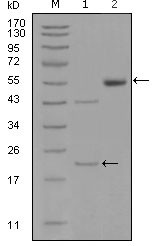
Figure 1: Western blot analysis using anti-EPHA5 monoclonal antibody against truncated EPHA5-His recombinant protein(1) and truncated EPHA5(aa620-774)-hIgGFc transfected CHO-K1 cell lysate(2).| Product Name | EphA5 Antibody |
|---|---|
| Antibody Type | Primary Antibodies |
| Clonality | Monoclonal |
|---|---|
| Isotype | IgG1 |
| Clone Number | 8B10B1,8B10F5 |
| Host Species | Mouse |
| Tested Applications | WB |
| WB:1:500 - 2000. |
|
| Species Reactivity | Human |
| Concentration | 1mg/ml |
| Gene Synonyms | BSK, EHK1, HEK7, TYRO4 |
|---|---|
| Alternative Names | CEK7 EHK1 HEK7 TYRO4 EPHA5 |
| Molecular Weight(MW) | 114803 Da |
| Function | Receptor tyrosine kinase which binds promiscuously GPI- anchored ephrin-A family ligands residing on adjacent cells, leading to contact-dependent bidirectional signaling into neighboring cells. The signaling pathway downstream of the receptor is referred to as forward signaling while the signaling pathway downstream of the ephrin ligand is referred to as reverse signaling. Among GPI-anchored ephrin-A ligands, EFNA5 most probably constitutes the cognate/functional ligand for EPHA5 Functions as an axon guidance molecule during development and may be involved in the development of the retinotectal, entorhino- hippocampal and hippocamposeptal pathways. Together with EFNA5 plays also a role in synaptic plasticity in adult brain through regulation of synaptogenesis. Beside its function in the nervous system, the interaction of EPHA5 with EFNA5 mediates communication between pancreatic islet cells to regulate glucose-stimulated insulin secretion (By similarity) |
| Tissue Specificity | Almost exclusively expressed in the nervous system in cortical neurons, cerebellar Purkinje cells and pyramidal neurons within the cortex and hippocampus. Display an increasing gradient of expression from the forebrain to hindbrain and spinal cord |
| Cellular Localization | Cell membrane (By similarity); Single-pass type I membrane protein (By similarity). Cell projection, axon (By similarity). Cell projection, dendrite |
| Entrez Gene | 2044 |
|---|---|
| Nucleotide Accession | NP_872272.2 |
Application
Figure 1: Western blot analysis using anti-EPHA5 monoclonal antibody against truncated EPHA5-His recombinant protein(1) and truncated EPHA5(aa620-774)-hIgGFc transfected CHO-K1 cell lysate(2).| Application Notes | WB:1:500 - 2000. |
|---|
| Form | Liquid |
|---|---|
| Storage Instructions | For short-term storage, store at 4° C. For long-term storage, aliquot and store at -20ºC or below. Avoid multiple freeze-thaw cycles. |
| Storage Buffer | Purified recombinant fragment of EphA5(aa620-774) expressed in E. Coli. |


