Application
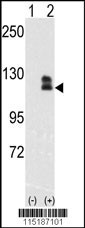
Western blot analysis of EphB2(arrow) using rabbit polyclonal EphB2 Antibody.293 cell lysates (2 ug/lane) either nontransfected (Lane 1) or transiently transfected with the EphB2 gene (Lane 2) (Origene Technologies).Application
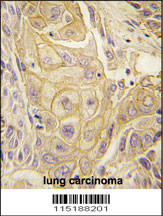
Formalin-fixed and paraffin-embedded human lung carcinoma tissue reacted with EphB2 antibody , which was peroxidase-conjugated to the secondary antibody, followed by DAB staining. This data demonstrates the use of this antibody for immunohistochemistry; clinical relevance has not been evaluated.Application
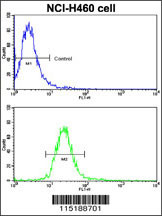
Flow cytometric analysis of NCI-H460 cells using EphB2 Antibody (bottom histogram) compared to a negative control cell (top histogram). FITC-conjugated goat-anti-rabbit secondary antibodies were used for the analysis.| Product Name | EphB2 Antibody |
|---|---|
| Antibody Type | Primary Antibodies |
| Clonality | Polyclonal |
|---|---|
| Isotype | Ig |
| Host Species | Rabbit |
| Tested Applications | WBIHCFC |
| WB:1:50~100 IHC |
|
| Species Reactivity | Human |
| Concentration | 1mg/ml |
| Gene Synonyms | DRT, EPHT3, EPTH3, ERK, HEK5, TYRO5 |
|---|---|
| Alternative Names | EPHB2 DRT EPHT3 EPTH3 ERK HEK5 TYRO5 Ephrin type-B receptor 2 Developmentally-regulated Eph-related tyrosine kinase ELK-related tyrosine kinase EPH tyrosine kinase 3 EPH-like kinase 5 Renal carcinoma antigen NY-REN-47 Tyrosine-protein kinase T |
| Molecular Weight(MW) | 117493 Da |
| Function | Receptor tyrosine kinase which binds promiscuously transmembrane ephrin-B family ligands residing on adjacent cells, leading to contact-dependent bidirectional signaling into neighboring cells. The signaling pathway downstream of the receptor is referred to as forward signaling while the signaling pathway downstream of the ephrin ligand is referred to as reverse signaling. Functions in axon guidance during development. Involved in the guidance of commissural axons, that form a major interhemispheric connection between the 2 temporal lobes of the cerebral cortex. Also involved in guidance of contralateral inner ear efferent growth cones at the midline and of retinal ganglion cell axons to the optic disk. Beside axon guidance, also regulates dendritic spines development and maturation and stimulates the formation of excitatory synapses. Upon activation by EFNB1, abolishes the ARHGEF15-mediated negative regulation on excitatory synapse formation. Controls other aspects of development including angiogenesis, palate development and in inner ear development through regulation of endolymph production. Forward and reverse signaling through the EFNB2/EPHB2 complex regulate movement and adhesion of cells that tubularize the urethra and septate the cloaca. May function as a tumor suppressor |
| Tissue Specificity | Brain, heart, lung, kidney, placenta, pancreas, liver and skeletal muscle. Preferentially expressed in fetal brain |
| Cellular Localization | Cell membrane; Single-pass type I membrane protein. Cell projection, axon (By similarity). Cell projection, dendrite (By similarity) |
| Entrez Gene | 2048 |
|---|
Application
Western blot analysis of EphB2(arrow) using rabbit polyclonal EphB2 Antibody.293 cell lysates (2 ug/lane) either nontransfected (Lane 1) or transiently transfected with the EphB2 gene (Lane 2) (Origene Technologies).
Application
Formalin-fixed and paraffin-embedded human lung carcinoma tissue reacted with EphB2 antibody , which was peroxidase-conjugated to the secondary antibody, followed by DAB staining. This data demonstrates the use of this antibody for immunohistochemistry; clinical relevance has not been evaluated.
Application
Flow cytometric analysis of NCI-H460 cells using EphB2 Antibody (bottom histogram) compared to a negative control cell (top histogram). FITC-conjugated goat-anti-rabbit secondary antibodies were used for the analysis.| Application Notes | WB:1:50~100 IHC |
|---|
| Form | Liquid |
|---|---|
| Storage Instructions | For short-term storage, store at 4° C. For long-term storage, aliquot and store at -20ºC or below. Avoid multiple freeze-thaw cycles. |
| Storage Buffer | Purified polyclonal antibody supplied in PBS with 0.09% (W/V) sodium azide. This antibody is prepared by Saturated Ammonium Sulfate (SAS) precipitation followed by dialysis against PBS. |


