Application
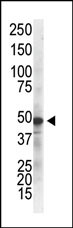
The anti-IKKgamma Mab (Cat. #AM8110a) is used in Western blot to detect IKKgamma in ZR75-1 cell lysate.| Product Name | IKK gamma Antibody |
|---|---|
| Antibody Type | Primary Antibodies |
| Clonality | Monoclonal |
|---|---|
| Isotype | IgG1 |
| Clone Number | 55AT986.5.78 |
| Host Species | Mouse |
| Tested Applications | WB |
| WB:1:100~500 |
|
| Species Reactivity | Human |
| Concentration | 1mg/ml |
| Gene Synonyms | FIP3, NEMO |
|---|---|
| Alternative Names | IKBKG FIP3 NEMO NF-kappa-B essential modulator FIP-3 IkB kinase-associated protein 1 Inhibitor of nuclear factor kappa-B kinase subunit gamma NF-kappa-B essential modifier |
| Molecular Weight(MW) | 48198 Da |
| Function | Regulatory subunit of the IKK core complex which phosphorylates inhibitors of NF-kappa-B thus leading to the dissociation of the inhibitor/NF-kappa-B complex and ultimately the degradation of the inhibitor. Its binding to scaffolding polyubiquitin seems to play a role in IKK activation by multiple signaling receptor pathways. However, the specific type of polyubiquitin recognized upon cell stimulation (either 'Lys-63'- linked or linear polyubiquitin) and its functional importance is reported conflictingly. Also considered to be a mediator for TAX activation of NF-kappa-B. Could be implicated in NF-kappa-B- mediated protection from cytokine toxicity (By similarity) Essential for viral activation of IRF3. Involved in TLR3- and IFIH1-mediated antiviral innate response; this function requires 'Lys-27'-linked polyubiquitination |
| Tissue Specificity | Heart, brain, placenta, lung, liver, skeletal muscle, kidney and pancreas |
| Cellular Localization | Cytoplasm. Nucleus. Note=Sumoylated NEMO accumulates in the nucleus in response to genotoxic stress |
| Entrez Gene | 8517 |
|---|
Application
The anti-IKKgamma Mab (Cat. #AM8110a) is used in Western blot to detect IKKgamma in ZR75-1 cell lysate.| Application Notes | WB:1:100~500 |
|---|
| Form | Liquid |
|---|---|
| Storage Instructions | For short-term storage, store at 4° C. For long-term storage, aliquot and store at -20ºC or below. Avoid multiple freeze-thaw cycles. |
| Storage Buffer | Purified monoclonal antibody supplied in PBS with 0.09% (W/V) sodium azide. This antibody is purified through a protein G column, eluted with high and low pH buffers and neutralized immediately, followed by dialysis against PBS. |


