Application
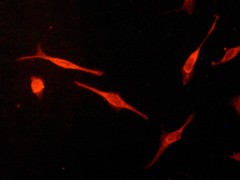
Immunofluorescent staining of HeLa cells using anti-ISG15 RabMAb (Cat. #AJ1420b).Application
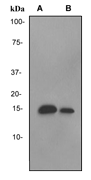
Western blot analysis on (A) HeLa treated with IFN-a and (B) Daudi cell lysates using anti-ISG15 RabMAb (Cat. #AJ1420b).| Product Name | ISG15 Antibody |
|---|---|
| Antibody Type | Primary Antibodies |
| Clonality | Monoclonal |
|---|---|
| Clone Number | EPR3446 |
| Host Species | Rabbit |
| Tested Applications | IFWB |
| WB:1:2000~5000 |
|
| Species Reactivity | Human |
| Concentration | 1mg/ml |
| Gene Synonyms | G1P2 UCRP |
|---|---|
| Molecular Weight(MW) | 17888 Da |
| Function | Ubiquitin-like protein that is conjugated to intracellular target proteins after IFN-alpha or IFN-beta stimulation. Its enzymatic pathway is partially distinct from that of ubiquitin, differing in substrate specificity and interaction with ligating enzymes. ISG15 conjugation pathway uses a dedicated E1 enzyme, but seems to converge with the Ub conjugation pathway at the level of a specific E2 enzyme. Targets include STAT1, SERPINA3G/SPI2A, JAK1, MAPK3/ERK1, PLCG1, EIF2AK2/PKR, MX1/MxA, and RIG-1. Deconjugated by USP18/UBP43. Shows specific chemotactic activity towards neutrophils and activates them to induce release of eosinophil chemotactic factors. May serve as a trans-acting binding factor directing the association of ligated target proteins to intermediate filaments. May also be involved in autocrine, paracrine and endocrine mechanisms, as in cell-to-cell signaling, possibly partly by inducing IFN-gamma secretion by monocytes and macrophages. Seems to display antiviral activity during viral infections |
| Tissue Specificity | Detected in lymphoid cells, striated and smooth muscle, several epithelia and neurons |
| Cellular Localization | Cytoplasm. Secreted. Note=UCRP conjugates seem to be noncovalently associated with the intermediate filaments and distributed in a punctate pattern. Also secreted |
| Entrez Gene | 9636 |
|---|
Application
Immunofluorescent staining of HeLa cells using anti-ISG15 RabMAb (Cat. #AJ1420b).
Application
Western blot analysis on (A) HeLa treated with IFN-a and (B) Daudi cell lysates using anti-ISG15 RabMAb (Cat. #AJ1420b).| Application Notes | WB:1:2000~5000 |
|---|
| Form | Liquid |
|---|---|
| Storage Instructions | For short-term storage, store at 4° C. For long-term storage, aliquot and store at -20ºC or below. Avoid multiple freeze-thaw cycles. |
| Storage Buffer | 50 mM Tris-Glycine (pH 7.4), 0.15 M NaCl, 40% Glycerol, 0.01% sodium azide and 0.05% BSA. |


