Application
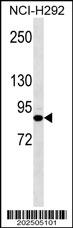
JUP Antibody (Ascites)(Cat. #AM2123a) western blot analysis in NCI-H292 cell line lysates (35ug/lane).This demonstrates the JUP antibody detected the JUP protein (arrow).| Product Name | JUP Antibody (Ascites) |
|---|---|
| Antibody Type | Primary Antibodies |
| Antigen Alias | JUP; CTNNG; DP3; Junction plakoglobin; Catenin gamma; Desmoplakin III; Desmoplakin-3 |
| Clonality | Monoclonal |
|---|---|
| Isotype | IgG3 |
| Clone Number | 606CT21.5.1 |
| Host Species | Mouse |
| Tested Applications | WB |
| WB:1:100~1600 |
|
| Species Reactivity | Human |
| Concentration | 1mg/ml |
| Gene Synonyms | CTNNG DP3 |
|---|---|
| Alternative Names | JUP CTNNG DP3 Junction plakoglobin Catenin gamma Desmoplakin III Desmoplakin-3 |
| Molecular Weight(MW) | 81745 Da |
| Function | Common junctional plaque protein. The membrane- associated plaques are architectural elements in an important strategic position to influence the arrangement and function of both the cytoskeleton and the cells within the tissue. The presence of plakoglobin in both the desmosomes and in the intermediate junctions suggests that it plays a central role in the structure and function of submembranous plaques. Acts as a substrate for VE-PTP and is required by it to stimulate VE- cadherin function in endothelial cells. Can replace beta-catenin in E-cadherin/catenin adhesion complexes which are proposed to couple cadherins to the actin cytoskeleton (By similarity) |
| Tissue Specificity | This JUP Monoclonal antibody is generated from mouses immunized with a KLH conjugated synthetic peptide selected from human JUP. |
| Cellular Localization | Cell junction, adherens junction. Cell junction, desmosome. Cytoplasm, cytoskeleton. Membrane; Peripheral membrane protein. Note=Cytoplasmic in a soluble and membrane- associated form |
| Entrez Gene | 3728 |
|---|---|
| Nucleotide Accession | NP_002221.1 |
Application
JUP Antibody (Ascites)(Cat. #AM2123a) western blot analysis in NCI-H292 cell line lysates (35ug/lane).This demonstrates the JUP antibody detected the JUP protein (arrow).| Application Notes | WB:1:100~1600 |
|---|
| Form | Liquid |
|---|---|
| Storage Instructions | For short-term storage, store at 4° C. For long-term storage, aliquot and store at -20ºC or below. Avoid multiple freeze-thaw cycles. |
| Storage Buffer | Mouse monoclonal antibody supplied in crude ascites with 0.09% (W/V) sodium azide. |


