Application
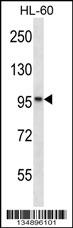
KANK2 Antibody (Center) western blot analysis in HL-60 cell line lysates (35ug/lane).This demonstrates the KANK2 antibody detected the KANK2 protein (arrow).| Product Name | KANK2 Antibody (Center) |
|---|---|
| Antibody Type | Primary Antibodies |
| Antigen Alias | KANK2; ANKRD25; KIAA1518; MXRA3; SIP; KN motif and ankyrin repeat domain-containing protein 2; Ankyrin repeat domain-containing protein 25; Matrix-remodeling-associated protein 3; SRC-1-interacting protein |
| Clonality | Polyclonal |
|---|---|
| Isotype | Ig |
| Host Species | Rabbit |
| Tested Applications | WB |
| WB:1:100~500 |
|
| Species Reactivity | Human |
| Concentration | 1mg/ml |
| Gene Synonyms | ANKRD25 KIAA1518 MXRA3 SIP |
|---|---|
| Alternative Names | KANK2 ANKRD25 KIAA1518 MXRA3 SIP KN motif and ankyrin repeat domain-containing protein 2 Ankyrin repeat domain-containing protein 25 Matrix-remodeling-associated protein 3 SRC-1-interacting protein |
| Molecular Weight(MW) | 91174 Da |
| Function | Involved in transcription regulation by sequestering nuclear receptor coactivators, such as NCOA1, NCOA2 and NCOA3, in the cytoplasm; the function is deregulated by phosphorylation. May be involved in the control of cytoskeleton formation by regulating actin polymerization. Involved in regulation of caspase- independent apoptosis; proposed to sequester AIFM1 in mitochondria and apoptotic stimuli lead to its proteasomal degradation allowing the release of AIFM1 to the nucleus. May be involved in promotion of cell proliferation |
| Tissue Specificity | Strongly expressed in cervix, colon, heart, kidney and lung. Expressed in kidney glomerular podocytes and mesangial cells (at protein level) |
| Cellular Localization | Cytoplasm. Mitochondrion. |
| Entrez Gene | 25959 |
|---|---|
| Nucleotide Accession | NP_056308.3 NP_001129663.1 |
Application
KANK2 Antibody (Center) western blot analysis in HL-60 cell line lysates (35ug/lane).This demonstrates the KANK2 antibody detected the KANK2 protein (arrow).| Application Notes | WB:1:100~500 |
|---|
| Form | Liquid |
|---|---|
| Storage Instructions | For short-term storage, store at 4° C. For long-term storage, aliquot and store at -20ºC or below. Avoid multiple freeze-thaw cycles. |
| Storage Buffer | Purified polyclonal antibody supplied in PBS with 0.09% (W/V) sodium azide. This antibody is purified through a protein A column, followed by peptide affinity purification. |


