Application
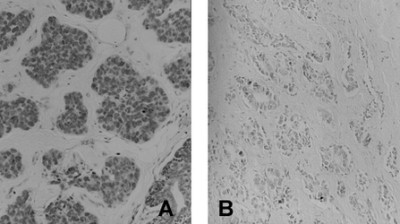
Immunohistochemistry: 4-amino Biphenyl DNA Antibody (4C11) [ - Human breast tumor tissue with high (A) and low (B) adduct levels.| Product Name | 4-amino Biphenyl DNA antibody |
|---|---|
| Antibody Type | Primary Antibodies |
| Product description | Mouse monoclonal to 4-amino Biphenyl DNA [clone 4C11]4-amino Biphenyl (4-ABP) is an aromatic amine (arylamine). 4-ABP can be found as a constituent of tobacco smoke, in the form of an environmental carcinogen. It is metabolized by hepatic cytochrome P4501A2 to yield a direct-acting mutagen known as N-hydroxy-aminobiphenyl. Yet, the accumulation of biologically active metabolites is dependent on the activation and detoxification of N-acetylation. 4-ABP has been shown to be a bladder carcinogen in humans and rodents. As well as genetic factors, 4-ABP may also play a role in breast cancer. It is hypothesized that smokers may have higher levels of DNA adducts than non-smokers and that the role of 4-ABP-DNA adducts and their relationship to tobacco exposure may be related to breast tumorigenesis. The antibody has been used to investigate the role of 4-ABP in the study of human breast cancer by measuring 4-ABP-DNA adducts. |
| Immunogen | 4-amino Biphenyl DNA |
| Clonality | Monoclonal |
|---|---|
| Clone Number | 4C11 |
| Host Species | Mouse |
| Tested Applications | ELISAICC/IFIHCIHC-FIHC-P |
| This antibody has specifically been used in ELISA. This clone has been shown to work in immunocytochemistry, immunofluorescence, and immunohistochemistry on both paraffin-embedded and frozen sections. Other applications have not been tested.Suggested working dilutions: *ELISA - (+)Immunohisto/cytochemistry - 1:50-1:100*The investigator should determine the optimal working dilution for a specific application.: |
|
| Concentration | 1mg/ml |
| Gene Synonyms | 4 AMBP DNA 4 aminobiphenyl DNA 4 amino Biphenyl DNA 4AMBP DNA 4aminobiphenyl DNA 4amino Biphenyl DNA |
|---|---|
| Target | 4-amino Biphenyl DNA |
| Tissue Specificity | This antibody is specific for 4-amino Biphenyl DNA. |
| Cellular Localization | Nuclear |
Application
Immunohistochemistry: 4-amino Biphenyl DNA Antibody (4C11) [ - Human breast tumor tissue with high (A) and low (B) adduct levels.| Application Notes | This antibody has specifically been used in ELISA. This clone has been shown to work in immunocytochemistry, immunofluorescence, and immunohistochemistry on both paraffin-embedded and frozen sections. Other applications have not been tested.Suggested working dilutions: *ELISA - (+)Immunohisto/cytochemistry - 1:50-1:100*The investigator should determine the optimal working dilution for a specific application.: |
|---|
| Form | Liquid |
|---|---|
| Storage Instructions | Store at 4 degrees C. Long term (> 6 months) aliquot and store at ñ20 degrees C. Avoid repeated freeze thaw cycles. |
| Storage Buffer | 0.1 ml of Protein G purified mouse ascites [1.4 mg/ml] in PBS containing 0.1% Sodium Azide. |


