Application
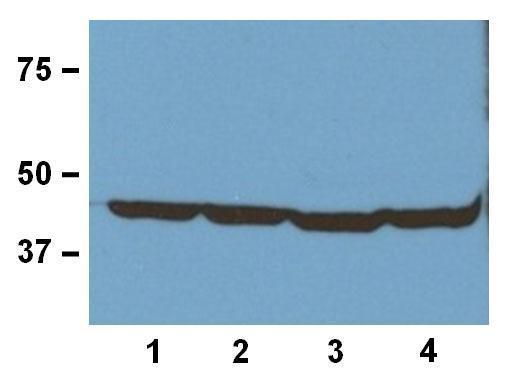
1:1000 (1μg/mL) Ab dilution used in WB of 20μg/lane tissue lysates from human (1), mouse (2), rat (3), and rabbit (4)| Product Name | Actin antibody |
|---|---|
| Antibody Type | Primary Antibodies |
| Product description | Mouse monoclonal antibody [BA3R] to ActinActin is a ubiquitous globular protein that is one of the most highly-conserved proteins known. It is foundin two main states; G-actin is the globular monomeric form, whereas F-actin forms helical polymers. Both G-and F-actin are intrinsically flexible structures - a feature vital in actin's role as a dynamic filamentnetwork. Actin has four major functions. Firstly, F-actin polymers form microfilaments - polar intracellular'tracks' for kinesin motor proteins, allowing the transport of vesicles, organelles and other cargo. Actinis a component of the cytoskeleton and links to alpha-actinin, E-cadherin and beta-catenin at adherensjunctions. This gives mechanical support to cells and attaches them to each other and the extracellularmatrix. In muscle cells, actin-rich thin filaments associate with myosin-rich thick filaments to formactomyosin myofibrils. Using energy from the hydrolysis of ATP, myofibrils undergo cyclic shortening throughactin-myosin head interactions, which represents the mechanics of muscle contraction. Finally, actin has arole in cell motility through polymerization and depolymerization of fibrils. |
| Immunogen | β-Actin N-terminal peptide-KLH conjugates |
| Clonality | Monoclonal |
|---|---|
| Isotype | IgG2 |
| Clone Number | BA3R |
| Host Species | Mouse |
| Tested Applications | ELISAICC/IFIHCWB |
| WB (with ECL): Use at a dilution of 1:1000-10000 : |
|
| Species Reactivity | HumanMouseChickenRatRabbit |
| Concentration | 1mg/ml (Please refer to the vial label for the specific concentration) |
| Purification | Affinity purified |
| Gene Synonyms | PS1TP5BP1 beta cytoskeletal actin Beta-actin Betaactin actin beta PS1TP5-binding protein 1 actin cytoplasmic1 actin cytoplasmic 1 PS1TP5binding protein1 PS1TP5binding protein 1 Beta actin PS1TP5 binding protein 1 |
|---|---|
| Target | Actin |
| Tissue Specificity | Recognizes native and denatured forms of β-Actin (∼42kDa) |
Application
1:1000 (1μg/mL) Ab dilution used in WB of 20μg/lane tissue lysates from human (1), mouse (2), rat (3), and rabbit (4)| Application Notes | WB (with ECL): Use at a dilution of 1:1000-10000 : |
|---|
| Form | Liquid |
|---|---|
| Storage Instructions | Store at 4°C (add 0.1% NaN3) for several days to weeks, and at -20°C for longer periods. Avoid repeated freeze-thaw cycles |
| Storage Buffer | 10mM PBS, pH 7.2 |


