Application
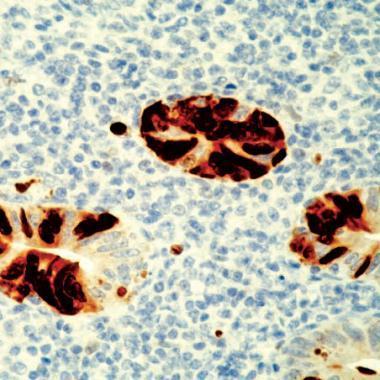
IHC image using - Detection of adenovirus by IHC in human infected appendix| Product Name | Adenovirus antibody |
|---|---|
| Antibody Type | Primary Antibodies |
| Product description | Mouse monoclonal [M58 + M73] to AdenovirusThe adenovirus early gene products E1A is a potent stimulator of cellular proliferation, which when overexpressed can overcome the growth inhibitory effects of TGF beta. The E1A region encodes a series of related proteins (35 - 46 kD) with multifunctional capabilities and forms a specific complex with the retinoblastoma tumor suppressor gene product. The E1a and E1B regions together comprise the transforming region of adenovirus. While expression of E1A alone is sufficient to immortalize primary cells, complete transformation requires the additional expression of the E1B region. |
| Immunogen | Adenovirus. |
| Clonality | Monoclonal |
|---|---|
| Isotype | IgG2a |
| Clone Number | M58 + M73 |
| Host Species | Mouse |
| Tested Applications | IHCIHC-FIHC-P |
| Immunohistochemistry (formalin fixed paraffin embedded / frozen sections): use at a dliution of 1/50 - 1/75 in an ABC method. Optimal dilutions / concentrations should be determined by the end user. Formalin fixed paraffin embedded tissue sections require high temperature antigen unmasking with 10 mM citrate buffer, pH 6.0 prior to immunostaining.: |
|
| Species Reactivity | Adenovirus |
| Concentration | 1mg/ml |
| Gene Synonyms | EIA |
|---|---|
| Target | Adenovirus |
| Cellular Localization | Nuclear. |
| Light Chain Type | kappa |
Application
IHC image using - Detection of adenovirus by IHC in human infected appendix| Positive Control | Suitable tissue control sections for Immunohistochemistry: Adenovirus infected tissue. |
|---|---|
| Application Notes | Immunohistochemistry (formalin fixed paraffin embedded / frozen sections): use at a dliution of 1/50 - 1/75 in an ABC method. Optimal dilutions / concentrations should be determined by the end user. Formalin fixed paraffin embedded tissue sections require high temperature antigen unmasking with 10 mM citrate buffer, pH 6.0 prior to immunostaining.: |
| Form | Liquid |
|---|---|
| Storage Instructions | Keep as concentrated solution, aliquot and store at 4°C. |
| Storage Buffer | Liquid with sodium azide |


