Application
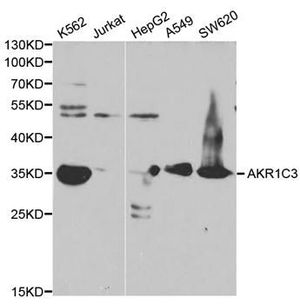
Western blot analysis of extracts of various cell line, using AKR1C3 antibody.Application
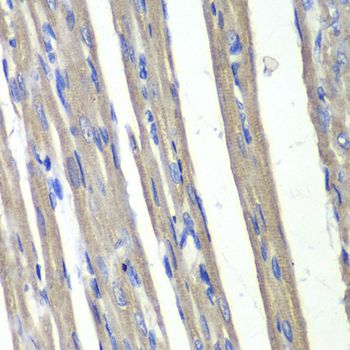
Immunohistochemistry of paraffin-embedded rat heart using AKR1C3 antibody at dilution of 1:100 (400x lens).| Product Name | AKR1C3 antibody |
|---|---|
| Antibody Type | Primary Antibodies |
| Product description | Rabbit Polyclonal antibody to AKR1C3This gene encodes a member of the aldo/keto reductase superfamily, which consists of more than 40 known enzymes and proteins. These enzymes catalyze the conversion of aldehydes and ketones to their corresponding alcohols by utilizing NADH and/or NADPH as cofactors. The enzymes display overlapping but distinct substrate specificity. This enzyme catalyzes the reduction of prostaglandin (PG) D2, PGH2 and phenanthrenequinone (PQ), and the oxidation of 9alpha,11beta-PGF2 to PGD2. It may play an important role in the pathogenesis of allergic diseases such as asthma, and may also have a role in controlling cell growth and/or differentiation. This gene shares high sequence identity with three other gene members and is clustered with those three genes at chromosome 10p15-p14. Three transcript variants encoding different isoforms have been found for this gene. [provided by RefSeq, Dec 2011] |
| Immunogen | Recombinant protein of human AKR1C3 |
| Clonality | Polyclonal |
|---|---|
| Isotype | IgG |
| Host Species | Rabbit |
| Tested Applications | IHCIHC-PWB |
| WB: 1:500 - 1:2000, IHC: 1:50 - 1:200: |
|
| Species Reactivity | HumanMouseRat |
| Concentration | 1mg/ml |
| Purification | Affinity purified |
| Gene Synonyms | hluPGFS HAKRe HA1753 PGFS HAKRB DD3 HSD17B5 DDX aldo-keto reductase family 1 member C3 |
|---|---|
| Target | AKR1C3 |
Application
Western blot analysis of extracts of various cell line, using AKR1C3 antibody.
Application
Immunohistochemistry of paraffin-embedded rat heart using AKR1C3 antibody at dilution of 1:100 (400x lens).| Application Notes | WB: 1:500 - 1:2000, IHC: 1:50 - 1:200: |
|---|
| Form | Liquid |
|---|---|
| Storage Instructions | Store at -20℃. Avoid freeze / thaw cycles. |
| Storage Buffer | PBS with 0.02% sodium azide, 50% glycerol, pH7.3. |


