Application
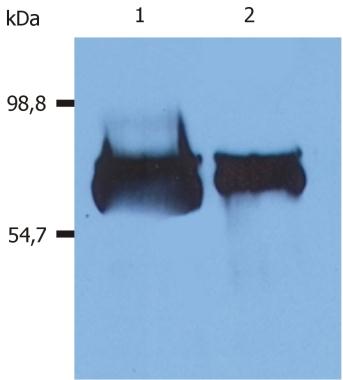
Western Blot analysis (reducing conditions) of human serum albumin using anti-human Albumin (AL-01) . Lane 1: Human blood plasma Lane 2: Human blood serum| Product Name | Albumin antibody |
|---|---|
| Antibody Type | Primary Antibodies |
| Product description | Mouse monoclonal antibody [AL-01] to AlbuminAlbumin is a soluble, monomeric protein which comprises about one-half of the blood serum protein. Albumin functions primarily as a carrier protein for steroids, fatty acids, and thyroid hormones and plays a role in stabilizing extracellular fluid volume. Albumin is a globular unglycosylated serum protein of molecular weight 65,000. Albumin is synthesized in the liver as preproalbumin which has an N-terminal peptide that is removed before the nascent protein is released from the rough endoplasmic reticulum. The product, proalbumin, is in turn cleaved in the Golgi vesicles to produce the secreted albumin. [provided by RefSeq] |
| Immunogen | Fraction of proteins containing albumin after ammonium sulphate precipitation and DEAE-chromatography of human serum. |
| Clonality | Monoclonal |
|---|---|
| Isotype | IgG1 |
| Clone Number | AL-01 |
| Host Species | Mouse |
| Tested Applications | ELISARIAWB |
| ELISA: Use at an assay dependant concentration. RIA: Use at an assay dependant concentration. WB: Use at an assay dependant concentration. Optimal dilutions/concentrations should be determined by the end user.: |
|
| Species Reactivity | Human |
| Concentration | 1mg/ml (Please refer to the vial label for the specific concentration) |
| Gene Synonyms | DKFZp779N1935 PRO0883 PRO0903 PRO1341 |
|---|---|
| Target | Albumin |
Application
Western Blot analysis (reducing conditions) of human serum albumin using anti-human Albumin (AL-01) . Lane 1: Human blood plasma Lane 2: Human blood serum| Application Notes | ELISA: Use at an assay dependant concentration. RIA: Use at an assay dependant concentration. WB: Use at an assay dependant concentration. Optimal dilutions/concentrations should be determined by the end user.: |
|---|
| Form | Liquid |
|---|---|
| Storage Instructions | Keep as concentrated solution. Store at 4°C short term. For extended storage aliquot and store at -20°C or below. Avoid freeze-thaw cycles. |
| Storage Buffer | Phosphate buffered saline pH 7.4 containing 15mM sodium azide |


