Application
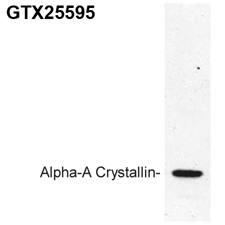
Western blot detection of alpha-A crystallin from bovine lens extract using| Product Name | alpha A Crystallin antibody |
|---|---|
| Antibody Type | Primary Antibodies |
| Product description | Rabbit Polyclonal antibody to alpha A CrystallinLens proteins consist almost entirely of crystallins (about 95%). Crystallins are also found vertebrate skeletal muscle tissue. In the lens, their structural function is to assist in maintaining the proper refractive index of the lens. The mammalian lens contains 3 major classes of crystallins: alpha, beta, and gamma. Alpha-crystallin is the largest of the crystallins and is composed of 2 primary gene products--alpha-A and alpha-B. There are at least 5 different proteins comprising the beta-crystallins. The gamma-crystallins are monomeric, but there are at least 5 gamma crystallins identified in bovine and rat lens. ? Alpha-Crystallin comprises 40% of total lens protein composition.? In addition to maintaining proper refractive index, it also functions in a chaperone like manner by preventing the formation of aggregates possibly leading to cataract formation.? It is believed that the phosphorylated states of the alpha-crystallin occur in response to cellular stress and may serve a structural control function and play a role in protein maintenance. Alpha-B crystallin has been linked to Alexander’s disease where it accumulates in brain cells of those afflicted. |
| Immunogen | Purified alpha-A Crystallin from bovine lens. |
| Clonality | Polyclonal |
|---|---|
| Host Species | Rabbit |
| Tested Applications | IHC-PWB |
| IHC-P: 10 ug/ml: |
|
| Species Reactivity | RatBovine |
| Concentration | 1mg/ml |
| Purification | Affinity purified |
| Gene Synonyms | CRYAA 281718 alpha A Crystallin |
|---|---|
| Target | alpha A Crystallin |
Application
Western blot detection of alpha-A crystallin from bovine lens extract using| Application Notes | IHC-P: 10 ug/ml: |
|---|
| Form | Liquid |
|---|---|
| Storage Instructions | Keep as concentrated solution. Aliquot and store at -20ºC or below. Avoid multiple freeze-thaw cycles. |
| Storage Buffer | lyophilized from PBS containing 30 mg/ml BSA and 0.05% sodium azide. |


