Application
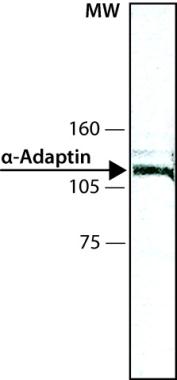
WB ImageRat cerebral cortex extract was separated on SDS-PAGE, blotted with 1:200 Monoclonal Anti-α-Adaptin (AP-2) Clone: 100/2 and developed using Goat Anti-Mouse IgG (Fab)-Biotin followed by ExtrAvidin-Peroxidase and AEC substrate.| Product Name | alpha Adaptin 2 antibody |
|---|---|
| Antibody Type | Primary Antibodies |
| Product description | Mouse monoclonal [100 / 2] to alpha Adaptin 2In eukaryotic cells, clathrin-coated vesicles mediate the selective internalization of cell-surface receptors for lysosomal enzymes from the trans-Golgi network to a pre-lysosomal compartment. Besides clathrin, coated vesicle populations contain the adaptor complexes AP1 and AP2, also known as HAI (HA1) adaptor and HAII (HA2) adaptor or Assemble Protein 1 (AP1) and Assemble Protein 2 (AP2), respectively. Interest has focused on adaptors because they are known to mediate the interaction between clathrin and components of the membrane. Their location between the clathrin shell and the membrane, as revealed by cryoelectron microscopy, is consistent with such a function. Under physiological conditions, in vitro adaptory proteins readily bind to clathrin and thereby induce its polymerization into regular polyhedral coat structures, very similar to the coats of coated vesicles. Clathrin-coated membranes at or originating from the plasma membrane contain the AP2 adaptor, while the AP1 adaptor appears to be largely restricted to clathrin-coated membranes of the trans-Golgi network. Both the Golgi associated AP1 adaptor and the plasma-membrane associated AP2 adaptor are heterotetrameric protein complexes. AP2 adaptor is made up of two 100-110 kD polypeptides, termed alpha and beta 2 (formerly beta) subunits, F2 (50 kD), and omega 2 (17 kD) subunit. alpha and beta 2 subunits (alpha and beta 2 adaptins) behave in standard SDS-PAGE like 100-112 kD polypeptides. Four alpha isoforms (alpha a1, alpha a2, alpha c1 and alpha c2) which are highly homologous in sequence have been described. beta 1 and beta 2 adaptins are highly homologous which suggests that the beta type adaptor chains may mediate the interaction of their adaptors with the highly conserved clathrin molecule. The alpha and gamma adaptins share only 25% overall identity. The other adaptor subunits of the two adaptor complexes which appear to be unrelated, are believed to possess binding sites for different cargo molecules (receptors) and for proteins which might regulate the complex functions of the adaptors. Monoclonal antibodies reacting specifically against adaptor proteins are useful tools for studies on the intracellular distribution and structural relationship of adaptor complexes. |
| Immunogen | AP2 polypeptides from bovine brain. |
| Clonality | Monoclonal |
|---|---|
| Isotype | IgG2a |
| Clone Number | 100/2 |
| Host Species | Mouse |
| Tested Applications | WB |
| WB: Use at a dilution of 1/200. Reacts in bovine and rat brain preparations, with the 105 and 110 ?-subunits of adaptor complex AP2. The antibody reacts with polypeptides of approximately 100 kDa in bovine liver, human heart fibroblasts, and Madin-Darby bovine kidney cultured cells (MDBK), but not with any components in the 110-115 kDa range from these sources or from rat pheochromocytoma cultured cells (PC12), neuroblastoma or astrocytes. The antibody stains the intact alpha adaptor, as well as the 37 and 40 kDa fragments, but not the 63-66 kDa group of alpha fragments obtained by trypsin cleavage of the alpha subunits molecules. Optimal dilutions/concentrations should be determined by the end user.: |
|
| Species Reactivity | HumanRatBovine |
| Concentration | 1mg/ml |
| Purification | Affinity purified |
| Target | alpha Adaptin 2 |
|---|---|
| Cellular Localization | Cytoplasmic |
Application
WB ImageRat cerebral cortex extract was separated on SDS-PAGE, blotted with 1:200 Monoclonal Anti-α-Adaptin (AP-2) Clone: 100/2 and developed using Goat Anti-Mouse IgG (Fab)-Biotin followed by ExtrAvidin-Peroxidase and AEC substrate.| Application Notes | WB: Use at a dilution of 1/200. Reacts in bovine and rat brain preparations, with the 105 and 110 ?-subunits of adaptor complex AP2. The antibody reacts with polypeptides of approximately 100 kDa in bovine liver, human heart fibroblasts, and Madin-Darby bovine kidney cultured cells (MDBK), but not with any components in the 110-115 kDa range from these sources or from rat pheochromocytoma cultured cells (PC12), neuroblastoma or astrocytes. The antibody stains the intact alpha adaptor, as well as the 37 and 40 kDa fragments, but not the 63-66 kDa group of alpha fragments obtained by trypsin cleavage of the alpha subunits molecules. Optimal dilutions/concentrations should be determined by the end user.: |
|---|
| Form | Liquid |
|---|---|
| Storage Instructions | Keep as concentrated solution. Store at 4ºC short term. For extended storage aliquot and store at -20ºC or below. Avoid freeze-thaw cycles. |
| Storage Buffer | Preservative: 0.1% Sodium Azide; Constituents: Ascites fluid |


