Application
ApplicationApplication
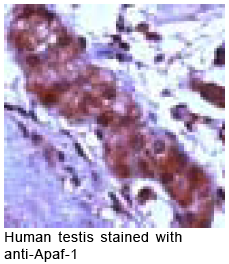
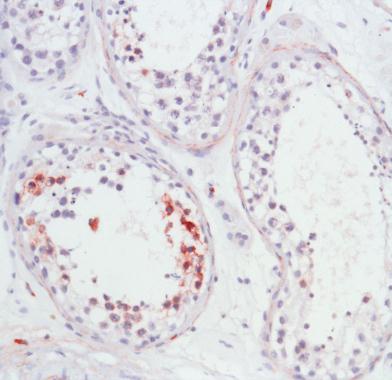
Human Testis stained with anti-Apoptosis Protease Activating Factor 1 (APAF-1) antibodyApplication
Human testis stained with| Product Name | APAF1 antibody (ready-to-use) |
|---|---|
| Antibody Type | Primary Antibodies |
| Product description | Rabbit polyclonal to APAF1 predilutedApoptosis is related to many diseases and induced by a family of cell death receptors and their ligands. Cell death signals are transduced by death domain containing adapter molecules and members of the caspase family of proteases. The mammalian homolog of the key cell death gene CED 4 in C. elegans was identified recently from human and mouse and designated APAF1 for Apoptosis protease-activating factor 1. APAF1 binds to Cytochrome c (APAF2) and Caspase 9 (APAF3), which leads to Caspase 9 activation. Activated Caspase 9 in turn cleaves and activates Caspase 3 that is one of the key proteases, being responsible for the proteolytic cleavage of many key proteins in apoptosis. APAF1 can also associate with Caspase 4 and Caspase 8. APAF1 transcript is ubiquitously expressed in human tissues. |
| Immunogen | Synthetic peptide (Human) (C terminal). |
| Clonality | Polyclonal |
|---|---|
| Isotype | IgG |
| Host Species | Rabbit |
| Tested Applications | IHCIHC-P |
| IHC-P: Ready to use. Staining of formalin-fixed tissues requires boiling tissue sections in 10mM Citrate buffer, pH 6.0 for 10 min followed by cooling at RT for 20 min. Optimal dilutions/concentrations should be determined by the end user. | |
| Species Reactivity | HumanMouseRat |
| Concentration | 1mg/ml |
| Purification | Affinity purified |
| Gene Synonyms | CED4, APAF1, 602233, O14727, 317 |
|---|---|
| Target | APAF1 |
| Cellular Localization | Cytoplasmic |
Application
Application
Application
Human Testis stained with anti-Apoptosis Protease Activating Factor 1 (APAF-1) antibody
Application
Human testis stained with| Positive Control | Testis cells |
|---|---|
| Application Notes | IHC-P: Ready to use. Staining of formalin-fixed tissues requires boiling tissue sections in 10mM Citrate buffer, pH 6.0 for 10 min followed by cooling at RT for 20 min. Optimal dilutions/concentrations should be determined by the end user. |
| Form | Liquid |
|---|---|
| Storage Instructions | Keep as concentrated solution and store at 4°C. Do not freeze. |
| Storage Buffer | PBS, pH 7.4 containing 1%BSA and 0.1% sodium azide |


