Application
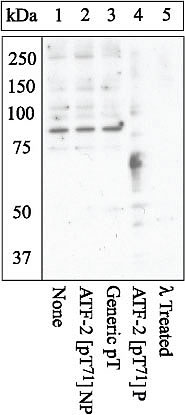
Extracts of NIH3T3 cells treated with 75 ng/mL anisomycin for 60 minutes were resolved by SDS-PAGE on a 10% polyacrylamide gel and transferred to PVDF. The membrane was blocked with a 5% BSA-TBST| Product Name | ATF2 (phospho Thr71) antibody |
|---|---|
| Antibody Type | Primary Antibodies |
| Product description | Rabbit polyclonal to ATF2 ( phospho T71 )This gene encodes a transcription factor that is a member of the leucine zipper family of DNA binding proteins. This protein binds to the cAMP-responsive element (CRE), an octameric palindrome. It forms a homodimer or a heterodimer with c-Jun and stimulates CRE-dependent transcription. This protein is also a histone acetyltransferase (HAT) that specifically acetylates histones H2B and H4 in vitro; thus it may represent a class of sequence-specific factors that activate transcription by direct effects on chromatin components. Several alternatively spliced transcript variants have been found for this gene. [provided by RefSeq, Jan 2012] |
| Immunogen | Synthetic peptide (Human) derived from a region of human ATF2 that contains threonine 71. The sequence is conserved in mouse, rat, chicken and frog. |
| Modification | p-Thr71 |
| Clonality | Polyclonal |
|---|---|
| Isotype | IgG |
| Host Species | Rabbit |
| Tested Applications | WB |
| WB: Use at a concentration of 0.35 - 1.0 μg/ml. Predicted molecular weight: 60 kDa. Optimal dilutions/concentrations should be determined by the end user.: |
|
| Species Reactivity | HumanMouseRatXenopus |
| Concentration | 0.5mg/ml |
| Purification | Affinity purified |
| Gene Synonyms | phospho ATF2 T71 ATF2 phospho Thr71 CREB2 Phospho ATF2 (pT71) TREB7 Phospho ATF2 (pThr71) ATF2 (pT71) Phospho ATF2 (Thr71) ATF2 T71 phospho ATF2 phospho T71 phospho ATF2 ATF2 Thr71 phospho ATF2 (Phospho Thr71) phospho |
|---|---|
| Target | ATF2 |
| Cellular Localization | Nuclear |
Application
Extracts of NIH3T3 cells treated with 75 ng/mL anisomycin for 60 minutes were resolved by SDS-PAGE on a 10% polyacrylamide gel and transferred to PVDF. The membrane was blocked with a 5% BSA-TBST| Positive Control | NIH3T3 cells +/- anisomycin |
|---|---|
| Application Notes | WB: Use at a concentration of 0.35 - 1.0 μg/ml. Predicted molecular weight: 60 kDa. Optimal dilutions/concentrations should be determined by the end user.: |
| Form | Liquid |
|---|---|
| Storage Instructions | For short-term storage, store at 4° C. For long-term storage, aliquot and store at -20ºC or below. Avoid multiple freeze-thaw cycles. |
| Storage Buffer | Preservative: 0.05% Sodium Azide; Constituents: PBS (without Mg2+ and Ca2+), 50% glycerol, 1.0mg/ml BSA (IgG, protease free). pH 7.3 |


