Application
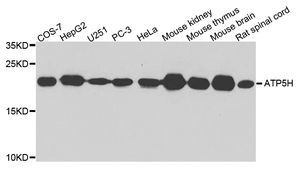
Western blot analysis of extract of various cells, using ATP5H antibody.| Product Name | ATP5H antibody |
|---|---|
| Antibody Type | Primary Antibodies |
| Product description | Rabbit Polyclonal antibody to ATP5HMitochondrial ATP synthase catalyzes ATP synthesis, utilizing an electrochemical gradient of protons across the inner membrane during oxidative phosphorylation. It is composed of two linked multi-subunit complexes: the soluble catalytic core, F1, and the membrane-spanning component, Fo, which comprises the proton channel. The F1 complex consists of 5 different subunits (alpha, beta, gamma, delta, and epsilon) assembled in a ratio of 3 alpha, 3 beta, and a single representative of the other 3. The Fo seems to have nine subunits (a, b, c, d, e, f, g, F6 and 8). This gene encodes the d subunit of the Fo complex. Alternatively spliced transcript variants encoding different isoforms have been identified for this gene. In addition, three pseudogenes are located on chromosomes 9, 12 and 15. [provided by RefSeq, Jun 2010] |
| Immunogen | Recombinant protein of human ATP5H |
| Clonality | Polyclonal |
|---|---|
| Isotype | IgG |
| Host Species | Rabbit |
| Tested Applications | ICC/IFIHC-PIPWB |
| WB 1:500 - 1:2000, IHC 1:20 - 1:200, IF 1:10 - 1:100, IP 1:20 - 1:50: |
|
| Species Reactivity | HumanMouseRat |
| Concentration | 1mg/ml |
| Purification | Affinity purified |
| Gene Synonyms | ATP synthase H+ transporting mitochondrial Fo complex subunit d ATPQ |
|---|---|
| Target | ATP5H |
| Molecular Weight(MW) | 18 kDa (note) |
Application
Western blot analysis of extract of various cells, using ATP5H antibody.| Application Notes | WB 1:500 - 1:2000, IHC 1:20 - 1:200, IF 1:10 - 1:100, IP 1:20 - 1:50: |
|---|
| Form | Liquid |
|---|---|
| Storage Instructions | Store at -20℃. Avoid freeze / thaw cycles. |
| Storage Buffer | PBS with 0.02% sodium azide, 50% glycerol, pH7.3. |


