Application
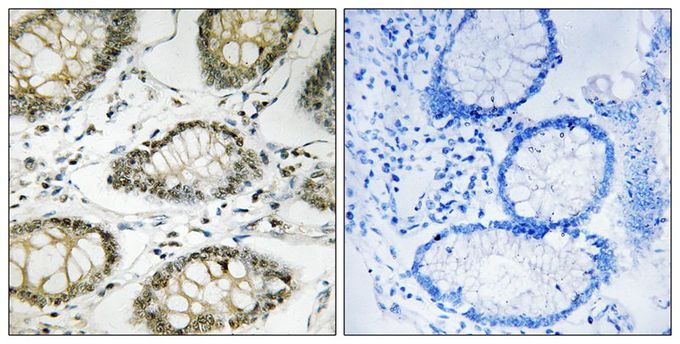
Immunohistochemistry analysis of paraffin-embedded human colon carcinoma tissue using ATR (Phospho-Ser428) antibody. The picture on the right is treated with the synthesized peptide.| Product Name | ATR (phospho Ser428) antibody |
|---|---|
| Antibody Type | Primary Antibodies |
| Product description | Rabbit Polyclonal antibody to ATR (phospho Ser428)The protein encoded by this gene belongs the PI3/PI4-kinase family, and is most closely related to ATM, a protein kinase encoded by the gene mutated in ataxia telangiectasia. This protein and ATM share similarity with Schizosaccharomyces pombe rad3, a cell cycle checkpoint gene required for cell cycle arrest and DNA damage repair in response to DNA damage. This kinase has been shown to phosphorylate checkpoint kinase CHK1, checkpoint proteins RAD17, and RAD9, as well as tumor suppressor protein BRCA1. Mutations of this gene are associated with Seckel syndrome. An alternatively spliced transcript variant of this gene has been reported, however, its full length nature is not known. Transcript variants utilizing alternative polyA sites exist. [provided by RefSeq, Jul 2008] |
| Immunogen | Peptide sequence around phosphorylation site of serine 428 (G-I-S(p)-P-K) derived from Human ATR. |
| Modification | p-Ser428 |
| Clonality | Polyclonal |
|---|---|
| Isotype | IgG |
| Host Species | Rabbit |
| Tested Applications | IHC-P |
| IHC: 1:50 - 1:100: |
|
| Species Reactivity | Human |
| Concentration | 1mg/ml (Please refer to the vial label for the specific concentration) |
| Purification | Affinity purified |
| Gene Synonyms | SCKL1 FRP1 FCTCS SCKL MEC1 ATR serine/threonine kinase ATR |
|---|---|
| Target | ATR (phospho Ser428) |
| Tissue Specificity | The antibody detects endogenous levels of ATR only when phosphorylated at serine 428. |
Application
Immunohistochemistry analysis of paraffin-embedded human colon carcinoma tissue using ATR (Phospho-Ser428) antibody. The picture on the right is treated with the synthesized peptide.| Application Notes | IHC: 1:50 - 1:100: |
|---|
| Form | Liquid |
|---|---|
| Storage Instructions | Store at -20˚C |
| Storage Buffer | Rabbit IgG in phosphate buffered saline (without Mg2+ and Ca2+), pH 7.4, 150mM NaCl, 0.02% sodium azide and 50% glycerol. |


