Application
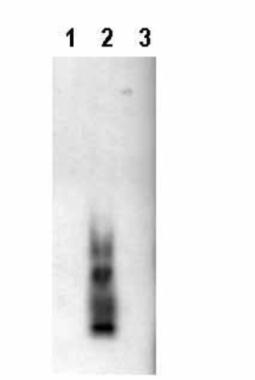
WB analysis of beta amyloid (1) 1-40 peptide, (2) 1-42 peptide and (3) 1-43 peptide using beta Amyloid (1-42) antibody [BDI780] at a concentration of 2 ug/ml.| Product Name | beta Amyloid (1-42) antibody [BDI780] |
|---|---|
| Antibody Type | Primary Antibodies |
| Product description | Mouse monoclonal antibody [BDI780] to beta Amyloid (1-42)This gene encodes a cell surface receptor and transmembrane precursor protein that is cleaved by secretases to form a number of peptides. Some of these peptides are secreted and can bind to the acetyltransferase complex APBB1/TIP60 to promote transcriptional activation, while others form the protein basis of the amyloid plaques found in the brains of patients with Alzheimer disease. Mutations in this gene have been implicated in autosomal dominant Alzheimer disease and cerebroarterial amyloidosis (cerebral amyloid angiopathy). Multiple transcript variants encoding several different isoforms have been found for this gene. [provided by RefSeq] |
| Clonality | Monoclonal |
|---|---|
| Isotype | IgG1 |
| Clone Number | BDI780 |
| Host Species | Mouse |
| Tested Applications | ELISAICC/IFWB |
| For ICC/IF: use at a dilution of 0.1-1 µg/mL | |
| Species Reactivity | Human |
| Concentration | 1mg/ml |
| Gene Synonyms | AAA, ABETA, ABPP, AD1, APPI, CTFgamma, CVAP, PN2 |
|---|---|
| Target | beta Amyloid (1-42) |
| Tissue Specificity | Amyloid, beta (1-42) C-terminal |
| Cellular Localization | Cell surface protein that rapidly becomes internalized via clathrin-coated pits. During maturation, the immature APP (N-glycosylated in the endoplasmic reticulum) moves to the Golgi complex where complete maturation occurs (O-glycosylated and sulfated). |
Application
WB analysis of beta amyloid (1) 1-40 peptide, (2) 1-42 peptide and (3) 1-43 peptide using beta Amyloid (1-42) antibody [BDI780] at a concentration of 2 ug/ml.| Application Notes | For ICC/IF: use at a dilution of 0.1-1 µg/mL |
|---|
| Form | Liquid |
|---|---|
| Storage Instructions | Upon receipt, store at –20°C. Avoid multiple freeze/thaw cycles. |
| Storage Buffer | PBS with PEG, Sucrose and 0.1% Sodium Azide. |


