Application
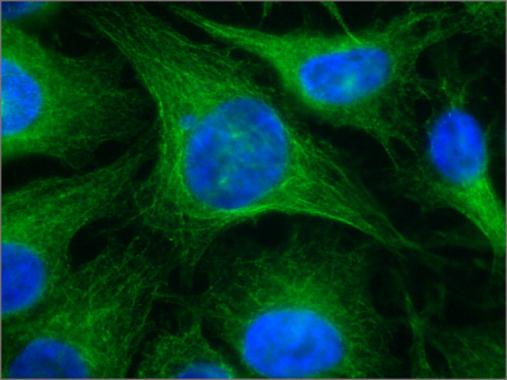
HeLa cells were fixed and permeabilized with 4% paraformaldehyde followed by 0.5% Polyethylene glycol tert-octylphenyl ether . Fixed cells were stained with 1:5,000 Monoclonal Anti-β-Tubulin I antibody Clone: SAP.4G5 . The antibody was developed using Goat Anti-Mouse IgG, Atto-488 conjugate. Cells were counterstained with DAPI (blue) to stain nuclei.Application
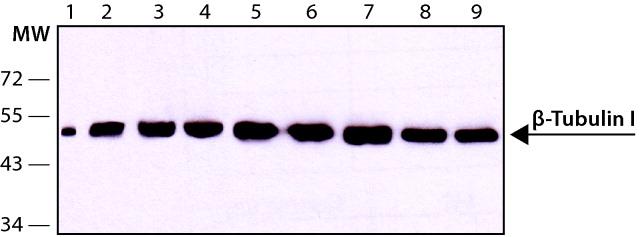
Cell line lysates were separated on SDS-PAGE and probed with 1:20,000 Monoclonal Anti-β-Tubulin I antibody Clone: SAP.4G5 . The antibody was developed using Goat Anti-Mouse IgG-Peroxidase and a chemiluminescent substrate. Lanes 1. Chicken Fibroblasts 2. Mouse brain extract I 3. Mouse brain extract II 4. Rat brain 5. Jurkat 6. Daudi 7. SK-Mel-28 8. G361 9. HeLa| Product Name | beta Tubulin I antibody [SAP.4G5] |
|---|---|
| Antibody Type | Primary Antibodies |
| Product description | Mouse monoclonal antibody [SAP.4G5] to beta Tubulin IThe major building block of microtubules is tubulin. Tubulin exists as a heterodimer of two similar but not identical polypeptides, designated alpha and beta, that assembles into microtubules. For beta-tubulin, six evolutionarily conserved isotypes were identified (designated beta I - beta VI). The most complex pattern of isotype distribution in tissues is seen in the vertebrate beta-tubulins. In mammals and birds, betaI is constitutive and found in most tissues. |
| Immunogen | Synthetic peptide corresponding to the C-terminal sequence of beta-tubulin isotype I, coupled to BSA. |
| Clonality | Monoclonal |
|---|---|
| Isotype | IgG1 |
| Clone Number | SAP.4G5 |
| Host Species | Mouse |
| Tested Applications | ELISAICC/IFIHCWB |
| ELISA: Use at an assay dependent dilution. ICC: Use at an assay dependent dilution (methanolacetone and 3% paraformaldehyde-0.5% Triton-x-100 fixations). IHC: Use at an assay dependent dilution (10% neutral buffered formalin-alcoholic formalin-xylene, paraffin-embedded). WB: Use at a dilution of 1/20000, this dilution is determined using cultured chicken fibroblasts. Predicted molecular weight: 55kDa. Optimal dilutions/concentrations should be determined by the end user. | |
| Species Reactivity | HumanMouseDogRatHamsterXenopusBovine |
| Concentration | 1mg/ml |
| Purification | Affinity purified |
| Gene Synonyms | P07437, OK/SWcl.56, M40, MGC16435, TUBB5, 191130, Tubulin beta I, TUBB, OK/SW-cl.56, MGC117247, TUBB1, 203068, OK/SW cl.56 |
|---|---|
| Target | beta Tubulin I |
| Tissue Specificity | No reactivity with other tubulin isotypes is observed. |
| Cellular Localization | Major constituent of microtubules. |
Application
HeLa cells were fixed and permeabilized with 4% paraformaldehyde followed by 0.5% Polyethylene glycol tert-octylphenyl ether . Fixed cells were stained with 1:5,000 Monoclonal Anti-β-Tubulin I antibody Clone: SAP.4G5 . The antibody was developed using Goat Anti-Mouse IgG, Atto-488 conjugate. Cells were counterstained with DAPI (blue) to stain nuclei.
Application
Cell line lysates were separated on SDS-PAGE and probed with 1:20,000 Monoclonal Anti-β-Tubulin I antibody Clone: SAP.4G5 . The antibody was developed using Goat Anti-Mouse IgG-Peroxidase and a chemiluminescent substrate. Lanes 1. Chicken Fibroblasts 2. Mouse brain extract I 3. Mouse brain extract II 4. Rat brain 5. Jurkat 6. Daudi 7. SK-Mel-28 8. G361 9. HeLa| Positive Control | Cultured chicken fibroblasts |
|---|---|
| Application Notes | ELISA: Use at an assay dependent dilution. ICC: Use at an assay dependent dilution (methanolacetone and 3% paraformaldehyde-0.5% Triton-x-100 fixations). IHC: Use at an assay dependent dilution (10% neutral buffered formalin-alcoholic formalin-xylene, paraffin-embedded). WB: Use at a dilution of 1/20000, this dilution is determined using cultured chicken fibroblasts. Predicted molecular weight: 55kDa. Optimal dilutions/concentrations should be determined by the end user. |
| Form | Liquid |
|---|---|
| Storage Instructions | Keep as concentrated solution. Store at 4ºC short term. For extended storage aliquot and store at -20ºC or below. Avoid freeze-thaw cycles. |
| Storage Buffer | Preservative: 15mM Sodium Azide; Constituents: Raw Ascites |


