Application
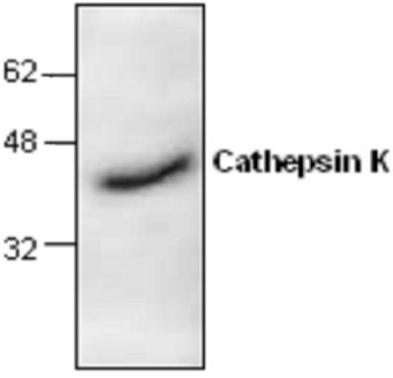
Western blot analysis of Cathepsin K with rat kidney tissue lysate.| Product Name | Cathepsin K antibody |
|---|---|
| Antibody Type | Primary Antibodies |
| Product description | Rabbit polyclonal antibody to Cathepsin KCathepsin family of proteases contains several diverse classes of enzymes. The cysteine protease class comprises cathepsin B, H, K, L, O, and S. The aspartyl protease class contains cathepsin D and E. Cathepsin G belongs to the serine protease class. Cathepsins are involved in various cellular events such as peptide biosynthesis, protein degradation, and apoptosis. Cathepsin K expression is highest in bone, cartilage, and skeletal muscle. |
| Clonality | Polyclonal |
|---|---|
| Isotype | IgG |
| Host Species | Rabbit |
| Tested Applications | IHCIPWB |
| For WB: use at a dilution of 0.5-4 µg/ml. For IHC: use at a dilution of 2.5 µg/ml. For IP: Use at an assay dependent concentration. However, the optimal conditions should be determined individually.: |
|
| Species Reactivity | HumanMouseChickenRatRabbit |
| Predicted Reactivity | Pig |
| Concentration | 1mg/ml |
| Purification | Affinity purified |
| Gene Synonyms | CTSO2 CTSO CTSK EC3.4.22.38 CTSO1 CTS02 PKND PYCD MGC23107 EC 3.4.22.38 |
|---|---|
| Target | Cathepsin K |
| Molecular Weight(MW) | proform (43 kDa), mature form (29 kDa) (note) |
| Tissue Specificity | This antibody is specific for Cathepsin K. |
Application
Western blot analysis of Cathepsin K with rat kidney tissue lysate.| Application Notes | For WB: use at a dilution of 0.5-4 µg/ml. For IHC: use at a dilution of 2.5 µg/ml. For IP: Use at an assay dependent concentration. However, the optimal conditions should be determined individually.: |
|---|
| Form | Liquid |
|---|---|
| Storage Instructions | Aliquot and store at -20°C. Avoid repeated freeze/thaw cycles. The antibody solution should be gently mixed before use. |
| Storage Buffer | PBS (pH 7.2) containing 30% glycerol, 0.5% BSA, 0.01% thimerosal |


