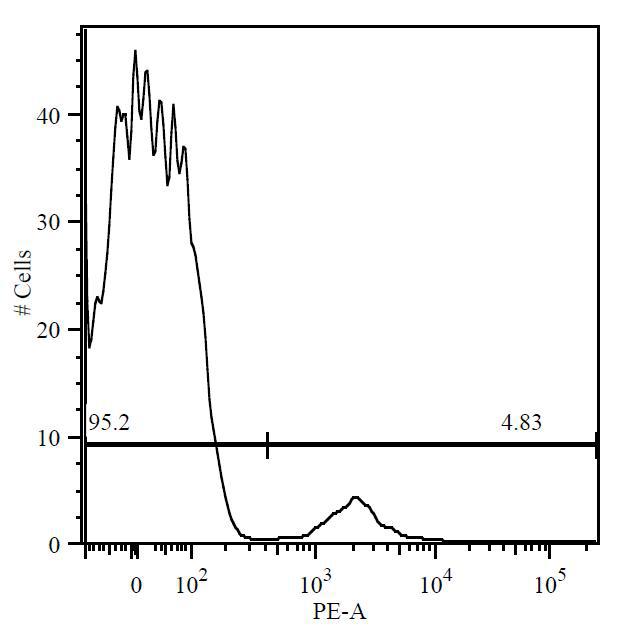
Application
Surface staining of human peripheral blood leukocytes with anti-human CD19 (4G7) purified .| Product Name | CD19 antibody |
|---|---|
| Antibody Type | Primary Antibodies |
| Product description | Mouse Monoclonal antibody [4G7] to CD19CD19 is a transmembrane glycoprotein of Ig superfamily expressed by B cells from the time of heavy chain rearrangement until plasma cell differentiation. It forms a tetrameric complex with CD21 (complement receptor type 2), CD81 (TAPA-1) and Leu13. Together with BCR (B cell antigen receptor), this complex signals to decrease B cell treshold for activation by the antigen. Besides being signal-amplifying coreceptor for BCR, CD19 can also signal independently of BCR coligation and it turns out to be a central regulatory component upon which multiple signaling pathways converge. Mutation of the CD19 gene results in hypogammaglobulinemia, whereas CD19 overexpression causes B cell hyperactivity.Entrez Gene: 16p11.2 |
| Immunogen | Human CCL (chronic lymphocytic leukemia) cells |
| Clonality | Monoclonal |
|---|---|
| Isotype | IgG1 |
| Clone Number | 4G7 |
| Host Species | Mouse |
| Tested Applications | FACSICC/IF |
| FACS: Use at 1 µg/mL: |
|
| Species Reactivity | Human |
| Concentration | 1mg/ml |
| Gene Synonyms | B4 MGC12802 |
|---|---|
| Target | CD19 |
| Tissue Specificity | The mouse monoclonal antibody 4G7 recognizes CD19 (B4), a 95 kDa type I transmembrane glycoprotein of immunoglobulin superfamily, expressed on B lymphocytes and follicular dendritic cells; it is lost on plasma cells. |
Application
Surface staining of human peripheral blood leukocytes with anti-human CD19 (4G7) purified .| Application Notes | FACS: Use at 1 µg/mL: |
|---|
| Form | Liquid |
|---|---|
| Storage Instructions | Store at 2-8°C. Do not use after expiration date stamped on vial label. For long-term storage aliquot and store at -20°C. Avoid freeze/thaw cycles. |
| Storage Buffer | Phosphate buffered saline (PBS) with 15 mM sodium azide, approx. pH 7.4 |


