Application
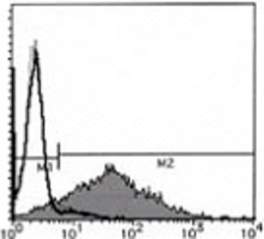
Flow cytometric analysis of CD154 expression on cells transfected with CD154 vector. Cells were stained with isotype control (open histogram) or CD40L (CD154) mAb (5F3) (shaded histogram).| Product Name | CD40L / CD154 antibody [5F3] |
|---|---|
| Antibody Type | Primary Antibodies |
| Product description | Mouse monoclonal [5F3] to CD40LCD40 ligand (CD40L), also known as CD154, gp39 and TRAP, is a 33 kDa type II membrane glycoprotein expressed mainly on the cell surface of activated T lymphocytes, but also exists as a soluble form extracellularly. CD40L is the ligand for CD40, a member of the TNF superfamily, which is expressed on the cell surface of B cells, macrophages/monocytes, dendritic cells, vascular endothelial cells, and epithelial cells. CD40L plays an important role in B cell proliferation, antibody class switching, modulation of apoptosis in the germinal center through interaction with B cells expressing CD40, and activation of CD4+ T cells. Mutation within the CD40L gene is linked to hyper IgM syndrome, an X-linked immunodeficiency disease that is characterized by elevated level of serum IgM and decreased level of other isotypes. |
| Immunogen | Human CD40L (CD154) transfected 300-19 cell (Mouse pre-B cell line). |
| Clonality | Monoclonal |
|---|---|
| Isotype | IgG1 |
| Clone Number | 5F3 |
| Host Species | Mouse |
| Tested Applications | FACS |
| FACS: Use at a concentration of 5 - 10 μg/ml. Optimal dilutions/concentrations should be determined by the end user. | |
| Species Reactivity | Human |
| Concentration | 1mg/ml (Please refer to the vial label for the specific concentration) |
| Purification | Protein A |
| Gene Synonyms | TRAP, IMD3, CD40L, 300386, 959, IGM, TNFSF5, HIGM1, CD40LG, CD154, gp39, TBAM, hCD40L, P29965, T-BAM, T BAM |
|---|---|
| Target | CD40L |
| Cellular Localization | Type II membrane protein. Also exists as an extracellular soluble form. |
Application
Flow cytometric analysis of CD154 expression on cells transfected with CD154 vector. Cells were stained with isotype control (open histogram) or CD40L (CD154) mAb (5F3) (shaded histogram).| Application Notes | FACS: Use at a concentration of 5 - 10 μg/ml. Optimal dilutions/concentrations should be determined by the end user. |
|---|
| Form | Liquid |
|---|---|
| Storage Instructions | Keep as concentrated solution. Store at 4ºC short term. For extended storage aliquot and store at -20ºC or below. Avoid freeze-thaw cycles. |
| Storage Buffer | Preservative: NoneConstituents: 1% Sucrose, PBS. pH 7.2. |


