Application
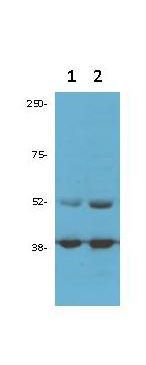
Genetex anti cdk9 antibody was used for Western blot analysis of 1) PC3 and 2) DU145 prostate cancer cells (50ug per lane). Bands at the expected MW of 55 and 42 Kda were detected.Application
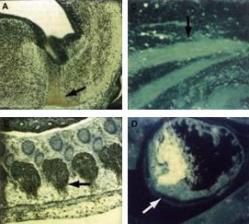
ICC staining of mouse tissue using anti-cdk9(PITALRE). The staining shows the location of mcdk9/PITALRE protein in developing mouse tissue. Arrows indicate areas of high expression. Panel A: Peroxidase-DAB immunostaining of mcdk9/PITALRE protein in the developing mouse brain in the differentiated region of the medulla oblongata just below the fourth ventricle. Similar staining is shown in Panel B in the dorsal root ganglia. Panel C: Fluorescein immunofluorescence of mcdk9IPITALRE in skeletal muscle. Similar staining is shown in Panel D in cardiac muscle. Sections from each specimen were cut at 5-7 µm, mounted on glass and dried overnight at 37°C. All sections then were deparaffinized in xylene, rehydrated through a graded alcohol series and washed in phosphate-buffered saline (PBS). PBS was used for all subsequent washes and for antiserum dilution. Tissue sections were quenched sequentially in 0.5% hydrogen peroxide and blocked with diluted 10% normal goat anti-rabbit serum. Slides were incubated at 20° C for 1 h with rabbit anti-cdk9 (1:500) dilution, washed, and then reacted with diluted goat anti-rabbit biotinylated antibody for 30 min. All the slides were then reacted with streptavidin-peroxidase conjugate for 30 min at 20° C. Diaminobenzidine was used as the final chromogen and hematoxylin was used as the nuclear counterstain. Negative controls for each tissue section were prepared by substituting the primary antiserum with pre-immune serum.| Product Name | CDK9 antibody |
|---|---|
| Antibody Type | Primary Antibodies |
| Product description | Rabbit Polyclonal antibody to CDK9CDK9 (PITALRE) (also known as cyclin-dependent kinase 9, Serine/threonine-protein kinase PITALRE, C-2K and Cell division cycle 2-like protein kinase 4) is a member of the cyclin-dependent protein kinase (CDK) family. CDK family members are highly similar to the gene products of S. cerevisiae cdc28, and S. pombe cdc2, and known as important cell cycle regulators. CDK9 (PITALRE) interacts with a conserved domain in the TRAF-C region of the tumor necrosis factor signal transducer TRAF2. This kinase also was found to be a component of the multiprotein complex TAK/P-TEFb, which is an elongation factor for RNA polymerase II-directed transcription and functions by phosphorylating the C-terminal domain of the largest subunit of RNA polymerase II. This protein forms a complex with and is regulated by its regulatory subunit cyclin T or cyclin K. HIV-1 Tat protein was found to interact with this protein and cyclin T, which suggested a possible involvement of this protein in AIDS. Tat stimulates human HIV-1 viral transcription elongation. This suggests that cyclin T1/cdk9(PITALRE) is one of the HIV-1 required host cellular cofactors generated during T cell activation. Cyclin T1/cdk9(PITALRE) is shown to interact with Tat to restore Tat activation in HeLa nuclear extracts depleted of P-TEFb. The cdk9(PITALRE) activity and cyclin T1 are essential for activation of transcription when tethered to the heterologous Rev response element RNA via the regulator of expression of virion Rev. CDK9 (PITALRE) is a ubiquitously expressed nuclear protein. |
| Immunogen | Multiple synthetic peptides corresponding to C-terminal and N-terminal domains of the protein coded by the human gene cdk9 (PITALRE). |
| Clonality | Polyclonal |
|---|---|
| Host Species | Rabbit |
| Tested Applications | ELISAIHC-PIPWB |
| *Optimal dilutions/concentrations should be determined by the researcher.
: |
|
| Species Reactivity | HumanMouseRat |
| Concentration | 1mg/ml |
| Purification | Affinity purified |
| Gene Synonyms | TAK CTK1 C2K CDC2L4 PITALRE |
|---|---|
| Target | CDK9 |
Application
Genetex anti cdk9 antibody was used for Western blot analysis of 1) PC3 and 2) DU145 prostate cancer cells (50ug per lane). Bands at the expected MW of 55 and 42 Kda were detected.
Application
ICC staining of mouse tissue using anti-cdk9(PITALRE). The staining shows the location of mcdk9/PITALRE protein in developing mouse tissue. Arrows indicate areas of high expression. Panel A: Peroxidase-DAB immunostaining of mcdk9/PITALRE protein in the developing mouse brain in the differentiated region of the medulla oblongata just below the fourth ventricle. Similar staining is shown in Panel B in the dorsal root ganglia. Panel C: Fluorescein immunofluorescence of mcdk9IPITALRE in skeletal muscle. Similar staining is shown in Panel D in cardiac muscle. Sections from each specimen were cut at 5-7 µm, mounted on glass and dried overnight at 37°C. All sections then were deparaffinized in xylene, rehydrated through a graded alcohol series and washed in phosphate-buffered saline (PBS). PBS was used for all subsequent washes and for antiserum dilution. Tissue sections were quenched sequentially in 0.5% hydrogen peroxide and blocked with diluted 10% normal goat anti-rabbit serum. Slides were incubated at 20° C for 1 h with rabbit anti-cdk9 (1:500) dilution, washed, and then reacted with diluted goat anti-rabbit biotinylated antibody for 30 min. All the slides were then reacted with streptavidin-peroxidase conjugate for 30 min at 20° C. Diaminobenzidine was used as the final chromogen and hematoxylin was used as the nuclear counterstain. Negative controls for each tissue section were prepared by substituting the primary antiserum with pre-immune serum.| Application Notes | *Optimal dilutions/concentrations should be determined by the researcher.
: |
|---|
| Form | Liquid |
|---|---|
| Storage Instructions | Store vial at -20° C prior to opening. Aliquot contents and freeze at -20° C or below for extended storage. Avoid cycles of freezing and thawing. |
| Storage Buffer | 0.02 M Potassium Phosphate, 0.15 M Sodium Chloride, pH 7.2 and 0.01% (w/v) Sodium Azide |


