Application
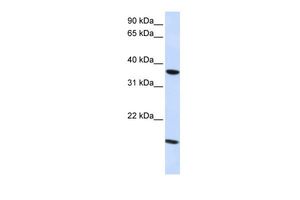
WB analysis of human fetal kidney tissue using Claudin 16 antibody at 1.25μg/ml.| Product Name | Claudin 16 antibody, C-term |
|---|---|
| Antibody Type | Primary Antibodies |
| Product description | Rabbit Polyclonal antibody to Claudin 16Tight junctions represent one mode of cell-to-cell adhesion in epithelial or endothelial cell sheets, forming continuous seals around cells and serving as a physical barrier to prevent solutes and water from passing freely through the paracellular space. These junctions are comprised of sets of continuous networking strands in the outwardly facing cytoplasmic leaflet, with complementary grooves in the inwardly facing extracytoplasmic leaflet. The protein encoded by this gene, a member of the claudin family, is an integral membrane protein and a component of tight junction strands. It is found primarily in the kidneys, specifically in the thick ascending limb of Henle, where it acts as either an intercellular pore or ion concentration sensor to regulate the paracellular resorption of magnesium ions. Defects in this gene are a cause of primary hypomagnesemia, which is characterized by massive renal magnesium wasting with hypomagnesemia and hypercalciuria, resulting in nephrocalcinosis an |
| Immunogen | A synthetic peptide corresponding to a C-terminal region of Human Claudin 16 |
| Clonality | Polyclonal |
|---|---|
| Isotype | IgG |
| Host Species | Rabbit |
| Tested Applications | WB |
| *Optimal dilutions/concentrations should be determined by the researcher.
: |
|
| Species Reactivity | Human |
| Predicted Reactivity | Cow: 86%; Dog: 86%; Horse: 93%; Human: 100%; Mouse: 86%; Pig: 86%; Rabbit: 93%; Rat: 86% |
| Concentration | 1mg/ml |
| Purification | Protein A |
| Gene Synonyms | PCLN1 CLDN16 HOMG3 |
|---|---|
| Target | Claudin 16 |
| Molecular Weight(MW) | 34 KDa (note) |
Application
WB analysis of human fetal kidney tissue using Claudin 16 antibody at 1.25μg/ml.| Positive Control | human fetal kidney |
|---|---|
| Application Notes | *Optimal dilutions/concentrations should be determined by the researcher.
: |
| Form | Liquid |
|---|---|
| Storage Instructions | Keep as concentrated solution. For short-term storage, store at 4ºC. For long-term storage, aliquot and store at -20ºC or below. Avoid multiple freeze-thaw cycles. |
| Storage Buffer | 1x PBS buffer with 0.09% (w/v) sodium azide and 2% sucrose. |


