Application
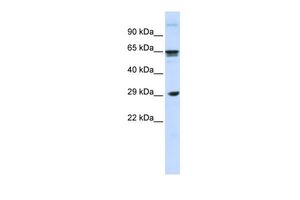
WB analysis of human muscle tissue using CLEC4M antibody at 0.2-1μg/ml.| Product Name | CLEC4M antibody, N-term |
|---|---|
| Antibody Type | Primary Antibodies |
| Product description | Rabbit Polyclonal antibody to CLEC4MThis gene encodes a transmembrane receptor and is often referred to as L-SIGN because of its expression in the endothelial cells of the lymph nodes and liver. The encoded protein is involved in the innate immune system and recognizes numerous evolutionarily divergent pathogens ranging from parasites to viruses, with a large impact on public health. The protein is organized into three distinct domains: an N-terminal transmembrane domain, a tandem-repeat neck domain and C-type lectin carbohydrate recognition domain. The extracellular region consisting of the C-type lectin and neck domains has a dual function as a pathogen recognition receptor and a cell adhesion receptor by binding carbohydrate ligands on the surface of microbes and endogenous cells. The neck region is important for homo-oligomerization which allows the receptor to bind multivalent ligands with high avidity. Variations in the number of 23 amino acid repeats in the neck domain of this protein are common and have a signifi |
| Immunogen | A synthetic peptide corresponding to a N-terminal region of Human CLEC4M |
| Clonality | Polyclonal |
|---|---|
| Isotype | IgG |
| Host Species | Rabbit |
| Tested Applications | WB |
| *Optimal dilutions/concentrations should be determined by the researcher.
: |
|
| Species Reactivity | Human |
| Predicted Reactivity | Human: 100%; Pig: 86% |
| Concentration | 1mg/ml |
| Purification | Affinity purified |
| Gene Synonyms | DC SIGN2 HP10347 DC SIGNR CD209L DCSIGNR CLEC4M LSIGN L SIGN CD299 |
|---|---|
| Target | CLEC4M |
| Molecular Weight(MW) | 45 KDa (note) |
Application
WB analysis of human muscle tissue using CLEC4M antibody at 0.2-1μg/ml.| Positive Control | human muscle |
|---|---|
| Application Notes | *Optimal dilutions/concentrations should be determined by the researcher.
: |
| Form | Liquid |
|---|---|
| Storage Instructions | Keep as concentrated solution. For short-term storage, store at 4ºC. For long-term storage, aliquot and store at -20ºC or below. Avoid multiple freeze-thaw cycles. |
| Storage Buffer | 1x PBS buffer with 0.09% (w/v) sodium azide and 2% sucrose. |


