Application
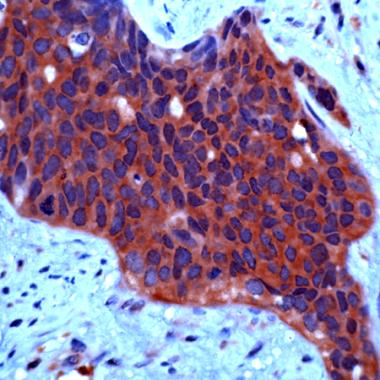
Human Ovarian Carcinoma stained with anti-c-Met antibody| Product Name | c-Met antibody (ready-to-use) |
|---|---|
| Antibody Type | Primary Antibodies |
| Product description | Rabbit polyclonal to Met (c-Met), predilutedc Met, a member of the tyrosine kinase superfamily, is the receptor for hepatocyte growth factor, also known as scatter factor (HGF/SF). The mature c Met protein is a disulfide-linked heterodimer with Mr=190 kDa composed of a heavily glycosylated alpha subunit that is completely extracellular in localization, and a beta subunit comprised of an extracellular ligand binding domain, a single transmembrane domain, and a cytoplasmic tyrosine kinase domain. Cells expressing c Met include epithelial cells, endothelial cells, blood cells of various types, and glomerular mesenchymal cells. HGF/SF binding to c Met stimulates receptor dimerization and the phosphorylation of numerous residues within the receptor?s cytoplasmic domain. Signaling proteins that are phosphorylated and/or localized in response to c Met phosphorylation include: Grb2, Shc, Cbl, Crk, cortactin, paxillin, GAB1, PI3K, FAK, Src, Ras, ERK1 and 2, JNK, PLC gamma, AKT, and STAT3. HGF/SF stimulation of c Met expressing cells enhances proliferation, migration, morphogenesis, and protease synthesis, characteristics that are associated with invasive cell phenotype. Many types of cancer exhibit sustained c Met stimulation, overexpression, or mutation, including carcinomas of the colon, breast, ovary, lung, liver, prostate, thyroid, kidney, as well as melanomas and sarcomas. In addition to cancer studies, other research areas in which c Met is under investigation include organogenesis, organ regeneration, angiogenesis and surgical wound healing. |
| Immunogen | Synthetic peptide: VDTRPASFWETS , corresponding to C terminal amino acids 1379-1390 of Human Met (c-Met) |
| Clonality | Polyclonal |
|---|---|
| Isotype | IgG |
| Host Species | Rabbit |
| Tested Applications | IHC-P |
| IHC-P: use neat for 10 min at room temperature. Perform heat mediated antigen retrieval before commencing with IHC staining protocol. In particular, boil tissue sections in 10mM citrate buffer pH 6.0 for 10 min and then cool at room temperature for 20 min. Not yet tested in other applications. Optimal dilutions/concentrations should be determined by the end user.: |
|
| Species Reactivity | Human |
| Concentration | 1mg/ml |
| Purification | Affinity purified |
| Gene Synonyms | c Met cMet AUTS9 HGFR RCCP2 c-Met |
|---|---|
| Target | c-Met |
| Tissue Specificity | recognises c-Met. |
| Cellular Localization | Type I membrane protein |
Application
Human Ovarian Carcinoma stained with anti-c-Met antibody| Positive Control | A431 cells, Human breast carcinoma, Human ovarian carcinoma |
|---|---|
| Application Notes | IHC-P: use neat for 10 min at room temperature. Perform heat mediated antigen retrieval before commencing with IHC staining protocol. In particular, boil tissue sections in 10mM citrate buffer pH 6.0 for 10 min and then cool at room temperature for 20 min. Not yet tested in other applications. Optimal dilutions/concentrations should be determined by the end user.: |
| Form | Liquid |
|---|---|
| Storage Instructions | Keep as concentrated solution, aliquot and store at 4°C. Do not freeze. |
| Storage Buffer | Phosphate-buffered saline, pH 7.2, containing 1%BSA and 0.09% sodium azide |


