Application
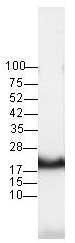
Western blot detection of human c-N-Ras.| Product Name | cN RAS antibody |
|---|---|
| Antibody Type | Primary Antibodies |
| Product description | Mouse monoclonal [F155 - 227] to cN RASThe human RAS gene family consists of three identified members which encode proteins of 21 kDa. Human cH RAS and cK RAS are the cellular homologs of vH- and vK RAS originally isolated from Harvey and Kirsten strains of rat sarcoma viruses. The third family member is designated cN RAS. Normal cellular RAS genes are referred to as proto-oncogenes and have the potential for activation to oncogenes by mutations occurring in codons 12, 13 and 61. Such mutated, activated and transforming RAS genes have been identified and isolated from human tumors and cultured tumor cells. Although the expression patterns of ras proto-oncogene proteins in normal human tissues are known, similar information for activated RAS oncogene encoded p21s and their relevance to human disease diagnosis and prognosis remains to be determined. |
| Immunogen | Recombinant p21 protein. |
| Clonality | Monoclonal |
|---|---|
| Isotype | IgG1 |
| Clone Number | F155-227 |
| Host Species | Mouse |
| Tested Applications | IHC-FIHC-PIPWB |
| For IHC-P: Use at a concentration of 8 - 12 μg/ml. Anti-trp E may be used as a negative control. Paraffin sections will require treatment with saponin (0.05% in water, 30 min.) or pepsin (0.1% in 0.1N HCl, 10-20 min.) at room temperature. For IHC-Fr: Use at a concentration of 8 - 12 μg/ml. For IP: Use 5 μg per sample with 45 μl of Protein G-agarose. For WB: Use at a concentration of 1-10μg/ml. This concentration is recommended using a neuronal cell extract. Predicted molecular weight: 21 kDa. Optimal dilutions/concentrations should be determined by the researcher.: |
|
| Species Reactivity | HumanMouseRat |
| Concentration | 1mg/ml |
| Target | cN RAS |
|---|---|
| Tissue Specificity | Monoclonal Anti-cN RAS reacts with cN RAS and vN RAS but not with cH RAS or cK RAS. |
| Light Chain Type | kappa |
Application
Western blot detection of human c-N-Ras.| Positive Control | Neuronal cells |
|---|---|
| Application Notes | For IHC-P: Use at a concentration of 8 - 12 μg/ml. Anti-trp E may be used as a negative control. Paraffin sections will require treatment with saponin (0.05% in water, 30 min.) or pepsin (0.1% in 0.1N HCl, 10-20 min.) at room temperature. For IHC-Fr: Use at a concentration of 8 - 12 μg/ml. For IP: Use 5 μg per sample with 45 μl of Protein G-agarose. For WB: Use at a concentration of 1-10μg/ml. This concentration is recommended using a neuronal cell extract. Predicted molecular weight: 21 kDa. Optimal dilutions/concentrations should be determined by the researcher.: |
| Form | Liquid |
|---|---|
| Storage Instructions | Keep as concentrated solution, aliquot and store at 4°C. Do not freeze. |
| Storage Buffer | 50 mM sodium phosphate buffer, 0.2% gelatin, pH 7.5, =0.1% sodium azide. |


