Application
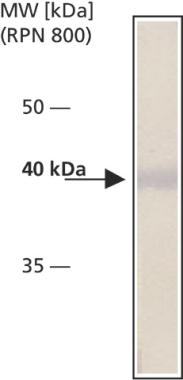
Rat brain extract was separated on SDS-PAGE and probed with Monoclonal PA to ARNO (Cytohesin-2) CL: CYT2-21 . The antibody was developed with Biotin APA Mouse Fab ad/HuBov, Hor as a second Ab, Alkaline Phosphatase conjugate as a tertiary reagent and a NBT/BCIP substrate. Antibody concentration 5 μg/mL.| Product Name | Cytohesin 2 antibody |
|---|---|
| Antibody Type | Primary Antibodies |
| Product description | Mouse monoclonal [CYT2 - 21] to Cytohesin 2ARFs (ADP ribosylation factors) are GTP-binding proteins (20 kDa), which catalyze ADP-ribosylation of the alpha-subunit of the adenylyl cyclase-stimulatory G protein. ARFs have been shown to regulate various aspects of vesicular trafficking pathways in mammalian cells, including endocytosis, phagocytosis, secretion, and endoplasmic reticulum protein transport and budding of transport vesicles from Golgi in both anterograde and retrograde directions. Mammalian ARFs are grouped into three classes (class I: ARFs 1, 2, and 3, class II: ARFs 4 and 5, and class III: ARF 6), based on size, gene structure, and sequence identity. ARFs are active when GTP, but not GDP or ATP, is bound. Hydrolysis of bound GTP to GDP with assistance of GTPase-activating protein, results in inactive ARF-GDP. Conversion of ARF-GDP to ARFGTP is promoted by GEP (guanine-exchange protein). The ARF-GEP family of guanine nucleotide-exchange proteins (also referred to as cytohesins) includes cytohesin 1, ARNO (ARF nucleotide binding site opener, also called cytohesin 2 or Sec7p), and GRP1 (general receptor for phosphoinositides-1, also known as cytohesin 3 or ARNO3). ARF-GEP family members are characterized by an N-terminal coiled-coil domain of 40 amino acids, a PtdIns(3,4,5)P3-binding C-terminal PH (pleckstrin homology) domain, and a central Sec7 domain. Sec7 is a conserved catalytic domain of approximately 200 amino acids, which stimulates the exchange of GDP to GTP on members of the ARF family of GTPases. The PH domain, by interacting with phospholipids, is believed to be responsible for association of cytoplasm with membranes. ARNO (47 kDa) appears as a dimer of approximately 90 kDa in gel filteration, but has an apparent molecular weight of approximately 40 kDa in SDS-PAGE. It is 83% homologous to cytohesin 1. However, while cytohesin 1 expression appears to be limited to hematopoietic cells, ARNO is more ubiquitously expressed. The catalytic activity of ARNO has been localized to the region of the Sec7 domain, and it appears to be positively regulated by interaction of the PH domain with inositol phospholipids. ARNO is localized to the plasma membrane in most mammlian cells, where it functions as an exchange factor for the plasma membrane-located ARF6 rather than ARF1. In HeLa cells, ARNO is mostly cytosolic, and its recruitment from cytosol to endosomes in the epithelial cells of the kidney, is pH-dependent. |
| Immunogen | Recombinant full length protein (Human). |
| Clonality | Monoclonal |
|---|---|
| Isotype | IgG1 |
| Clone Number | CYT2-21 |
| Host Species | Mouse |
| Tested Applications | ELISAICC/IFWB |
| ELISA: Use at an assay dependent dilution. ICC: Use at an assay dependent dilution. WB: Use at a concentration of 5 - 10 μg/ml, this concentration is determined using a whole extract of rat brain. Predicted molecular weight: 40 kDa. Optimal dilutions/concentrations should be determined by the end user.: |
|
| Species Reactivity | HumanRat |
| Concentration | 1mg/ml |
| Purification | Protein A |
| Gene Synonyms | 602488 Sec7pL Sec7p-L Cytohesin2 ARNO PSCD2 Cytohesin 2 Q99418 9266 CTS18.1 Sec7p L |
|---|---|
| Target | Cytohesin 2 |
| Tissue Specificity | does not cross-react with other members of the cytohesin family. |
| Cellular Localization | Plasma membrane |
Application
Rat brain extract was separated on SDS-PAGE and probed with Monoclonal PA to ARNO (Cytohesin-2) CL: CYT2-21 . The antibody was developed with Biotin APA Mouse Fab ad/HuBov, Hor as a second Ab, Alkaline Phosphatase conjugate as a tertiary reagent and a NBT/BCIP substrate. Antibody concentration 5 μg/mL.| Positive Control | Whole extract of rat brain |
|---|---|
| Application Notes | ELISA: Use at an assay dependent dilution. ICC: Use at an assay dependent dilution. WB: Use at a concentration of 5 - 10 μg/ml, this concentration is determined using a whole extract of rat brain. Predicted molecular weight: 40 kDa. Optimal dilutions/concentrations should be determined by the end user.: |
| Form | Liquid |
|---|---|
| Storage Instructions | Upon receipt - Keep as concentrated solution. Aliquot and store at -20ºC or below. Avoid freeze-thaw cycles. |
| Storage Buffer | Preservative: 15mM Sodium Azide; Constituents: 0.01M PBS. pH 7.4 |


