Application
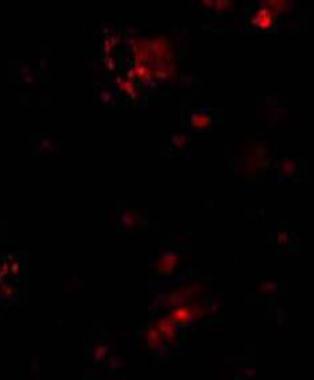
Immunofluorescent staining of DcR1 in rat liver tissue with DcR1 antibody at 10μg/ml.Application
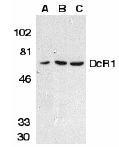
Western blot analysis of DcR1 in HeLa cell (A), mouse (B) and rat (C) liver tissue lysates with DcR1 antibody at 1μg/ml.| Product Name | DcR1 antibody |
|---|---|
| Antibody Type | Primary Antibodies |
| Product description | Rabbit polyclonal to DcR1Apoptosis is induced by certain cytokines including TNF and Fas ligand in the TNF family through their death domain containing receptors. TRAIL/Apo2L is a new member of the TNF family and induces apoptosis of a variety of tumor cell lines. DR4 and DR5 are the recently identified functional receptors for TRAIL (1-3). Two decoy receptors for TRAIL have been identified and designatedDcR1/TRID/TRAIL-R3/LIT (2-7) and DcR2/TRAIL-R4/TRUNDD (8-10). DcR1 has extracellular TRAIL-binding domain but lacks intracellular signaling domain. It is a glycophospholipid-anchored cell surface protein. DcR1 transcripts were expressed in many normal human tissues but not in most cancer cell lines (2,3). Overexpression of DcR1 did not induce apoptosis, but attenuated TRAIL-induced apoptosis (2,3). |
| Immunogen | Synthetic peptide: amino acids 111-123 of Human DcR1 |
| Clonality | Polyclonal |
|---|---|
| Isotype | IgG |
| Host Species | Rabbit |
| Tested Applications | ICC/IFWB |
| For WB: Use at a dilution of 1:500-1:1,000. Optimal dilutions/concentrations should be determined by the researcher.: |
|
| Species Reactivity | HumanMouseRat |
| Concentration | 0.5mg/ml |
| Purification | Affinity purified |
| Gene Synonyms | DCR1 8794 TRID 603613 TNFRSF10C LIT TRAILR3 O14798 |
|---|---|
| Target | DcR1 |
Application
Immunofluorescent staining of DcR1 in rat liver tissue with DcR1 antibody at 10μg/ml.
Application
Western blot analysis of DcR1 in HeLa cell (A), mouse (B) and rat (C) liver tissue lysates with DcR1 antibody at 1μg/ml.| Positive Control | HeLa whole cell lysate |
|---|---|
| Application Notes | For WB: Use at a dilution of 1:500-1:1,000. Optimal dilutions/concentrations should be determined by the researcher.: |
| Form | Liquid |
|---|---|
| Storage Instructions | Keep as concentrated solution. Aliquot and store at -20ºC or below. Avoid freeze-thaw cycles. |
| Storage Buffer | Phosphate-buffered saline, pH 7.4 containing 0.02% sodium azide |


 Data sheet for OM249523