Application
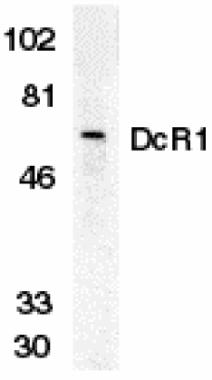
Western blot analysis of DcR1 in HeLa whole cell lysate with DcR1 antibody at 1 ug/ml.Application
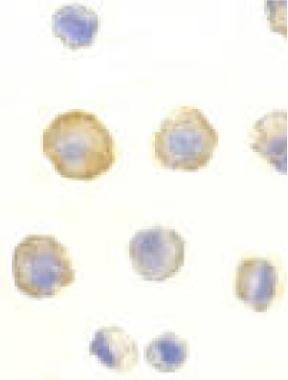
Immunocytochemical staining of DcR1 in HeLa cells with DcR1 antibody at 10μg/ml.| Product Name | DcR1 antibody |
|---|---|
| Antibody Type | Primary Antibodies |
| Product description | Rabbit polyclonal to DcR1Apoptosis is induced by certain cytokines including TNF and Fas ligand in the TNF family through their death domain containing receptors. TRAIL/Apo2L is a new member of the TNF family and induces apoptosis of a variety of tumor cell lines. DR4 and DR5 are the recently identified functional receptors for TRAIL. Two decoy receptors for TRAIL have been identified and designated DcR1/TRID/TRAILR3/ LIT and DcR2/TRAIL-R4/TRUNDD. DcR1 has extracellular TRAIL-binding domain but lacks intracellular signaling domain. It is a glycophospholipidanchored cell surface protein. DcR1 transcripts were expressed in many normal human tissues but not in most cancer cell lines. Overexpression of DcR1 did not induce apoptosis, but attenuated TRAIL-induced apoptosis. |
| Immunogen | Synthetic peptide - amino acids 149-167 at the extracellular domain of DcR1 precursor |
| Clonality | Polyclonal |
|---|---|
| Isotype | IgG |
| Host Species | Rabbit |
| Tested Applications | ICC/IFWB |
| For WB: Use at a dilution of 1:500-1:1,000. Optimal dilutions/concentrations should be determined by the researcher.: |
|
| Species Reactivity | HumanMouseRat |
| Concentration | 0.5mg/ml |
| Purification | Affinity purified |
| Gene Synonyms | DCR1 8794 TRID 603613 TNFRSF10C LIT TRAILR3 O14798 |
|---|---|
| Target | DcR1 |
Application
Western blot analysis of DcR1 in HeLa whole cell lysate with DcR1 antibody at 1 ug/ml.
Application
Immunocytochemical staining of DcR1 in HeLa cells with DcR1 antibody at 10μg/ml.| Positive Control | HeLa whole cell lysate |
|---|---|
| Application Notes | For WB: Use at a dilution of 1:500-1:1,000. Optimal dilutions/concentrations should be determined by the researcher.: |
| Form | Liquid |
|---|---|
| Storage Instructions | Keep as concentrated solution. Aliquot and store at -20ºC or below. Avoid freeze-thaw cycles. |
| Storage Buffer | Phosphate-buffered saline, pH 7.4 containing 0.02% sodium azide |


 Data sheet for OM249525