Application
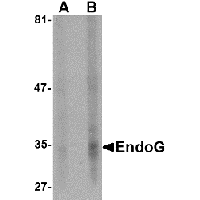
Western blot analysis of EndoG expression in HepG2 cell lysate with EndoG antibody at (A) 5 and (B) 10 μg/mL.| Product Name | EndoG antibody [7F2G10] |
|---|---|
| Antibody Type | Primary Antibodies |
| Product description | Mouse monoclonal antibody to EndoG [7F2G10]The fragmentation of nuclear DNA is a hallmark of apoptotic cell death. The activities of caspase and nuclease are involved in the DNA fragmentation. Caspase-activated deoxyribonuclease (CAD), also termed DNA fragmentation factor (DFF40), is one such nuclease, and is capable of inducing DNA fragmentation and chromatin condensation after cleavage by caspase-3 of its inhibitor ICAD/DFF45. Caspase and CAD independent DNA fragmentation also exists. Recent studies demonstrated that another nuclease, endonuclease G (EndoG), is specifically activated by apoptotic stimuli and is able to induce nucleosomal fragmentation of DNA independently of caspase and DFF/CAD. EndoG is a mitochondrion-specific nuclease that translocates to the nucleus and cleaves chromatin DNA during apoptosis. The homologue of mammalian EndoG is the first mitochondrial protein identified to be involved in apoptosis in C. elegans. EndoG also cleaves DNA in vitro. |
| Immunogen | Recombinant protein corresponding to amino acids 51 – 140 of human EndoG. |
| Clonality | Monoclonal |
|---|---|
| Clone Number | 7F2G10 |
| Host Species | Mouse |
| Tested Applications | ELISAWB |
| Species Reactivity | HumanRat |
| Concentration | 1mg/ml |
| Purification | Affinity purified |
| Gene Synonyms | EndoG (7F2G10): Endonuclease G |
|---|---|
| Target | EndoG |
| Tissue Specificity | This antibody is specific for EndoG |
Application
Western blot analysis of EndoG expression in HepG2 cell lysate with EndoG antibody at (A) 5 and (B) 10 μg/mL.| Form | Liquid |
|---|---|
| Storage Instructions | Keep as concentrated solution. Aliquot and store at -20ºC or below. Avoid multiple freeze-thaw cycles. |
| Storage Buffer | Antibody is supplied in PBS containing 0.02% sodium azide |


