Application
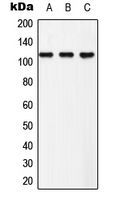
Western blot analysis of EPHB3 (pY608) expression in Hela (A); NIH3T3 (B); PC12 (C) whole cell lysates.| Product Name | EphB3 (phospho Tyr608) antibody |
|---|---|
| Antibody Type | Primary Antibodies |
| Product description | Rabbit Polyclonal antibody to EphB3 (phospho Tyr608)Ephrin receptors and their ligands, the ephrins, mediate numerous developmental processes, particularly in the nervous system. Based on their structures and sequence relationships, ephrins are divided into the ephrin-A (EFNA) class, which are anchored to the membrane by a glycosylphosphatidylinositol linkage, and the ephrin-B (EFNB) class, which are transmembrane proteins. The Eph family of receptors are divided into two groups based on the similarity of their extracellular domain sequences and their affinities for binding ephrin-A and ephrin-B ligands. Ephrin receptors make up the largest subgroup of the receptor tyrosine kinase (RTK) family. This gene encodes a receptor for ephrin-B family members. [provided by RefSeq, Mar 2010] |
| Immunogen | KLH-conjugated synthetic peptide encompassing a sequence within the center region of human EPHB3 (pY608). The exact sequence is proprietary. |
| Modification | p-Tyr608 |
| Clonality | Polyclonal |
|---|---|
| Isotype | IgG |
| Host Species | Rabbit |
| Tested Applications | WB |
| WB: 1:500 - 1:1000: |
|
| Species Reactivity | HumanMouseRat |
| Concentration | 1mg/ml |
| Purification | Affinity purified |
| Gene Synonyms | ETK2 EPHB3 EPH receptor B3 TYRO6 HEK2 |
|---|---|
| Target | EphB3 (phospho Tyr608) |
| Tissue Specificity | Recognizes endogenous levels of EPHB3 (pY608) protein. |
Application
Western blot analysis of EPHB3 (pY608) expression in Hela (A); NIH3T3 (B); PC12 (C) whole cell lysates.| Application Notes | WB: 1:500 - 1:1000: |
|---|
| Form | Liquid |
|---|---|
| Storage Instructions | Shipped at 4 °C. Upon delivery aliquot and store at -20 °C for one year. Avoid freeze/thaw cycles. |
| Storage Buffer | Liquid in 0.42% Potassium phosphate; 0.87% Sodium chloride; pH 7.3; 30% glycerol; and 0.01% sodium azide. |


