Application
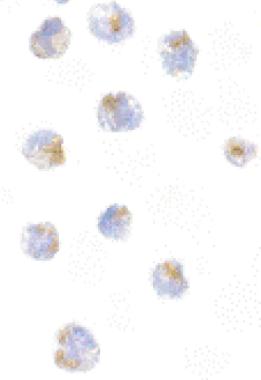
Immunocytochemical staining of NIH/3T3 cells with mFLIP antibody at 5ug/mlApplication
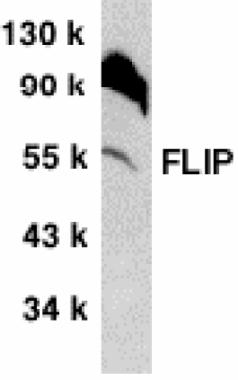
Western blot analysis of mFLIP in NIH/3T3 whole cell lysate with anti-mFLIP (CT) at 2ug/ml.| Product Name | FLIP antibody |
|---|---|
| Antibody Type | Primary Antibodies |
| Product description | Rabbit polyclonal to FLIPApoptosis is related to many diseases and induced by a family of cell death receptors and their ligands. Cell death signals are transduced by death domain (DD) containing adapter molecules and members of the ICE/CED-3protease family. Caspases-8 (FLICE) and -10 (FLICE2) are two pivotal members in the ICE/CED-3 protease family. FLICE-inhibitory proteins were identified in virus and human and designated v-FLIPs and FLIP respectively (1,2). The human FLIP was also cloned by several labs independently and termed Casper, I-FLICE, FLAME-1, CASH, CLARP and MRIT (3-8). FLIP contains two death effector domains (DEDs) and a caspase-like domain. FLIP interacts with adapter protein FADD and caspase-8 and-10, and potently inhibits apoptosis induced by all known death receptors CD95, DR3, TRAIL-R and TNFR1. |
| Immunogen | Peptide corresponding to C-terminus of mouse FLIPL/CASH alpha form |
| Clonality | Polyclonal |
|---|---|
| Isotype | IgG |
| Host Species | Rabbit |
| Tested Applications | ICC/IFWB |
| For WB: Use at a dilution of 500 - 1:1,000. Optimal concentrations/dilutions should be determined by the researcher.: |
|
| Species Reactivity | Human |
| Concentration | 0.5mg/ml |
| Purification | Affinity purified |
| Gene Synonyms | Q01543 SIC1 SIC-1 FLI1 FLIP EWSR2 2313 193067 SIC 1 |
|---|---|
| Target | FLIP |
| Tissue Specificity | FLIP has two forms, a short form, FLIPS, and long form, FLIPL; this antibody recognizes the FLIPL form. |
| Cellular Localization | Cytoplasmic |
Application
Immunocytochemical staining of NIH/3T3 cells with mFLIP antibody at 5ug/ml
Application
Western blot analysis of mFLIP in NIH/3T3 whole cell lysate with anti-mFLIP (CT) at 2ug/ml.| Positive Control | Whole cell lysate NIH3T3 cells |
|---|---|
| Application Notes | For WB: Use at a dilution of 500 - 1:1,000. Optimal concentrations/dilutions should be determined by the researcher.: |
| Form | Liquid |
|---|---|
| Storage Instructions | Upon Receipt - Keep as concentrated solution. Aliquot and store at -20ºC or below. Avoid freeze-thaw cycles. |
| Storage Buffer | PBS, pH 7.4 with 0.02% sodium azide as preservative |


