Application
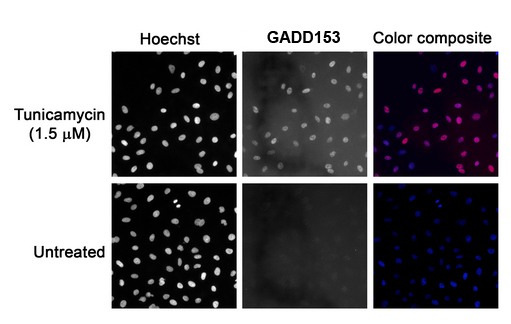
Immunofluorescence staining of GADD153 in A549 cells treated with media only (non-treated) or with 1.5 µM tunicamycin for 6 hours. Cells were stained according to the kit protocol.Application
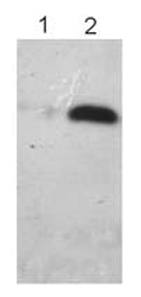
Western blot analysis of endogenous GADD153 from primary human fibroblasts using GADD153 Monoclonal Antibody . Lane 1: Untreated cells Lane 2: Cells treated with tunicamycin for 10 hours.Application
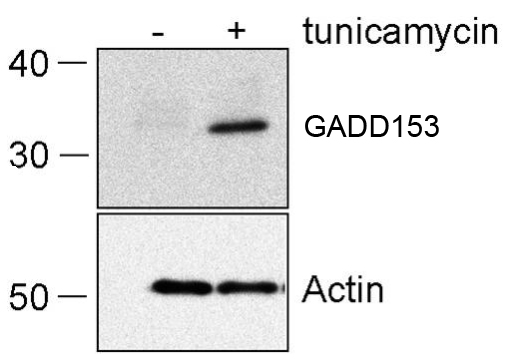
Western blot analysis of HeLa cell lysates using GADD153 Monoclonal Antibody . HeLa cells were left untreated (-) or treated with tunicamycin (5µg/ml) for 11 hours (+). Membranes containing whole cell extracts were blocked with 5% milk in TBST (blocking buffer) and probed overnight at 4ºC with (diluted 1:2000 in blocking buffer), followed by a goat anti-mouse IgG-HRP secondary antibody (diluted in blocking buffer) and a chemiluminescent substrate. Membranes were also probed for actin as a loading control.| Product Name | GADD153 antibody |
|---|---|
| Antibody Type | Primary Antibodies |
| Product description | Mouse monoclonal antibody [9C8] to GADD153GADD153 is a small nuclear protein that is capable of dimerizing with transcription factors C/EBP alpha and beta. Once dimerized, this complex inhibits the normal binding and function of C/EBP to classical binding sites. Inversely, the C/EBP-CHOP dimer gains binding activity to other non-classical C/EBP stress related targets. Under normal cellular conditions this protein is not expressed in detectable levels, but is highly unregulated during times of cellular/ER stress. Examples of CHOP inducing stress include: treatment with tunicamycin, nutrient starvation and reducing agents that interfere with the calcium flux across the ER membrane. |
| Immunogen | Bacterially expressed, mouse CHOP (GADD153) fusion protein. |
| Clonality | Monoclonal |
|---|---|
| Isotype | IgG2 |
| Clone Number | 9C8 |
| Host Species | Mouse |
| Tested Applications | ICC/IFIHC-FIHC-PIPWB |
| WB: 1:10: |
|
| Species Reactivity | HumanMouseRat |
| Concentration | 1mg/ml (Please refer to the vial label for the specific concentration) |
| Gene Synonyms | DDIT3 126337 MGC4154 CEBPZ P35638 CHOP CHOP10 GADD153 1649 |
|---|---|
| Target | GADD153 |
Application
Immunofluorescence staining of GADD153 in A549 cells treated with media only (non-treated) or with 1.5 µM tunicamycin for 6 hours. Cells were stained according to the kit protocol.
Application
Western blot analysis of endogenous GADD153 from primary human fibroblasts using GADD153 Monoclonal Antibody . Lane 1: Untreated cells Lane 2: Cells treated with tunicamycin for 10 hours.
Application
Western blot analysis of HeLa cell lysates using GADD153 Monoclonal Antibody . HeLa cells were left untreated (-) or treated with tunicamycin (5µg/ml) for 11 hours (+). Membranes containing whole cell extracts were blocked with 5% milk in TBST (blocking buffer) and probed overnight at 4ºC with (diluted 1:2000 in blocking buffer), followed by a goat anti-mouse IgG-HRP secondary antibody (diluted in blocking buffer) and a chemiluminescent substrate. Membranes were also probed for actin as a loading control.| Application Notes | WB: 1:10: |
|---|
| Form | Liquid |
|---|---|
| Storage Instructions | Upon Receipt - Keep as concentrated solution. Aliquot and store at -20ºC or below. Avoid freeze-thaw cycles. |
| Storage Buffer | Phosphate-buffered saline containing 0.05% sodium azide |


