Application
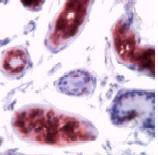
Human skin stained withApplication
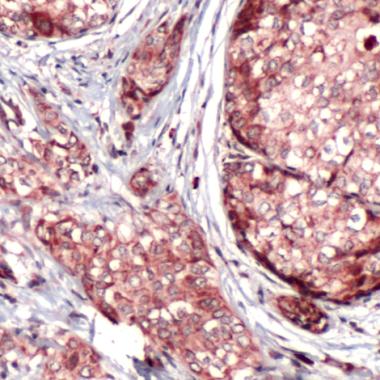
Human Breast Carcinoma stained with anti-Bnip3L antibody| Product Name | GCDFP15 antibody [SPM135] |
|---|---|
| Antibody Type | Primary Antibodies |
| Product description | Mouse monoclonal [SPM135] to GCDFP15Gross cystic disease of the breast is benign premenopausal disorder in which cysts are a predominant pathological lesion. These cysts appear to be formed from excessive apocrine cystic secretions. This fluid is composed of several glycoproteins including a unique 15kDa monomer protein, Gross Cystic Disease Fluid Protein-15 (GCDFP15). Cytosolic analysis of normal tissue specimens from all major organs has demonstrated GCDFP15 in apocrine epithelia, lacrimal, ceruminous and Moll's glands and in numerous serous cells of the submandibular, tracheal, bronchial, sublingual and minor salivary glands. GCDFP15 and prostate specific antigen are co-expressed in androgen receptor-positive breast tumours. |
| Immunogen | Recombinant protein encoding the excreted domain of human GCDFP15. |
| Clonality | Monoclonal |
|---|---|
| Isotype | IgG2a |
| Clone Number | SPM135 |
| Host Species | Mouse |
| Tested Applications | IHCIHC-P |
| IHC-P: Use at a dilution of 1/30 for 10 minutes at RT. Staining of formalin-fixed tissues requires boiling tissue sections in 10mM citrate buffer, pH 6.0 for 10 minutes followed by cooling at RT for 20 minutes. GTX15300 demonstrates cytoplasmic staining. Optimal dilutions/concentrations should be determined by the end user. | |
| Species Reactivity | HumanRat |
| Concentration | 1mg/ml |
| Purification | Unpurified |
| Gene Synonyms | PIP, 176720, GP17, P12273, 5304, GCDGP15, GCDFP-15, GCDFP15, GCDFP 15 |
|---|---|
| Target | GCDGP15 |
| Light Chain Type | kappa |
Application
Human skin stained with
Application
Human Breast Carcinoma stained with anti-Bnip3L antibody| Application Notes | IHC-P: Use at a dilution of 1/30 for 10 minutes at RT. Staining of formalin-fixed tissues requires boiling tissue sections in 10mM citrate buffer, pH 6.0 for 10 minutes followed by cooling at RT for 20 minutes. GTX15300 demonstrates cytoplasmic staining. Optimal dilutions/concentrations should be determined by the end user. |
|---|
| Form | Liquid |
|---|---|
| Storage Instructions | Keep as concentrated solution, aliquot and store at 4°C. Do not freeze. |
| Storage Buffer | Phosphate-buffered saline, pH 7.4 containing 1% BSA and 0.09% sodium azide |


