Application
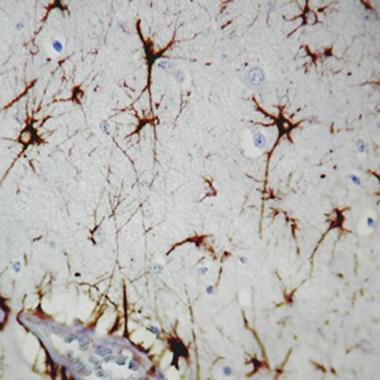
Formalin fixed paraffin embedded human brain stained with GFAP antibody (cat. # ).| Product Name | GFAP antibody (ready-to-use) |
|---|---|
| Antibody Type | Primary Antibodies |
| Product description | Mouse monoclonal [GA - 5] to GFAP - Astrocyte Marker predilutedGlial fibrillary acidic protein (GFAP) is a member of the class III intermediate filament protein family. It is heavily and specifically expressed in astrocytes and certain other astroglia in the central nervous system, in satellite cells in peripheral ganglia, and in non-myelinating Schwann cells in peripheral nerves. In addition neural stem cells frequently strongly express GFAP. Antibodies to GFAP are therefore very useful as markers of astrocytic cells. In addition many types of brain tumor, presumably derived from astrocytic cells, heavily express GFAP. GFAP is also found in the lens epithelium, Kupffer cells of the liver, in some cells in salivary tumors and has been reported in erythrocytes. Neuroblastomas, Schwannomas, as well as extra-CNS tumors are not labeled. Negative staining has been observed with lymphatic tissue, muscle, gastrointestinal tract, liver, kidney, pancreas and bladder. |
| Immunogen | GFAP isolated from porcine spinal cord. |
| Clonality | Monoclonal |
|---|---|
| Isotype | IgG1 |
| Clone Number | GA-5 |
| Host Species | Mouse |
| Tested Applications | IHC-P |
| This antibody is ready to use.For best results use heat mediated antigen retrieval, this can enhance staining if tissues are over-fixed.Do not use enzymatic mediated antigen retrieval. We recommend incubating sections with the antibody for 30-60 minutes at room temperature.: |
|
| Species Reactivity | Human |
| Concentration | 1mg/ml |
| Gene Synonyms | P14136 137780 FLJ45472 2670 GFAP |
|---|---|
| Target | GFAP |
| Tissue Specificity | This antibody reacts with human GFAP. It shows no cross-reaction with other intermediate filaments. Anti-GFAP stains astrocytes, ependymal cells and corresponding tumors. |
Application
Formalin fixed paraffin embedded human brain stained with GFAP antibody (cat. # ).| Positive Control | Normal brain or astrocytoma |
|---|---|
| Application Notes | This antibody is ready to use.For best results use heat mediated antigen retrieval, this can enhance staining if tissues are over-fixed.Do not use enzymatic mediated antigen retrieval. We recommend incubating sections with the antibody for 30-60 minutes at room temperature.: |
| Form | Liquid |
|---|---|
| Storage Instructions | Keep as concentrated solution, aliquot and store at 4°C. Do not freeze. |
| Storage Buffer | PBS pH7.3 with protein carrier and preservative |


