Application
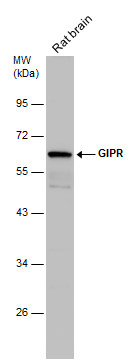
Rat tissue extract (50 μg) was separated by 10% SDS-PAGE, and the membrane was blotted with GIPR antibody diluted at 1:500.| Product Name | GIPR antibody |
|---|---|
| Antibody Type | Primary Antibodies |
| Product description | Rabbit Polyclonal antibody to GIPR (gastric inhibitory polypeptide receptor)Gastric inhibitory polypeptide (GIP; MIM 137240), also called glucose-dependent insulinotropic polypeptide, is a 42-amino acid polypeptide synthesized by K cells of the duodenum and small intestine. It was originally identified as an activity in gut extracts that inhibited gastric acid secretion and gastrin release, but subsequently was demonstrated to stimulate insulin release potently in the presence of elevated glucose. The insulinotropic effect on pancreatic islet beta-cells was then recognized to be the principal physiologic action of GIP. Together with glucagon-like peptide-1, GIP is largely responsible for the secretion of insulin after eating. It is involved in several other facets of the anabolic response.[supplied by OMIM] |
| Immunogen | Carrier-protein conjugated synthetic peptide encompassing a sequence within the N-terminus region of human GIPR. The exact sequence is proprietary. |
| Clonality | Polyclonal |
|---|---|
| Isotype | IgG |
| Host Species | Rabbit |
| Tested Applications | WB |
| *Optimal dilutions/concentrations should be determined by the researcher.
: |
|
| Species Reactivity | Rat |
| Predicted Reactivity | HumanHuman (100%) |
| Concentration | 0.5mg/ml |
| Purification | Affinity purified |
| Gene Synonyms | gastric inhibitory polypeptide receptor PGQTL2 |
|---|---|
| Target | GIPR |
| Molecular Weight(MW) | 53 kDa (note) (2) |
| Cellular Localization | Cell membrane; Multi-pass membrane protein |
Application
Rat tissue extract (50 μg) was separated by 10% SDS-PAGE, and the membrane was blotted with GIPR antibody diluted at 1:500.| Positive Control | rat brain |
|---|---|
| Application Notes | *Optimal dilutions/concentrations should be determined by the researcher.
: |
| Form | Liquid |
|---|---|
| Storage Instructions | Keep as concentrated solution. Aliquot and store at -20ºC or below. Avoid multiple freeze-thaw cycles. |
| Storage Buffer | 1XPBS, 20% Glycerol (pH7). 0.025% ProClin 300 was added as a preservative. |


