Application
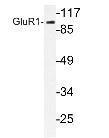
Western Blot: GluR1 Antibody [ - extracts from COS-7 cells.Application
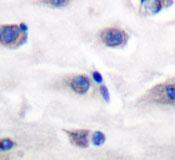
Immunohistochemistry: GluR1 Antibody [ - GluR1 Antibody [ - paraffin-embedded human brain tissue.| Product Name | GluR1 antibody |
|---|---|
| Antibody Type | Primary Antibodies |
| Product description | Rabbit polyclonal antibody to GluR1Glutamate receptors mediate most excitatory neurotransmission in the brain and play an important role in neural plasticity, neural development and neurodegeneration. Ionotropic glutamate receptors are categorized into NMDA receptors and kainate/AMPA receptors, both of which contain glutamategated, caution-specific ion channels. Kainate/AMPA receptors are co-localized with NMDA receptors in many synapses and consist of seven structurally related subunits designated GluR-1 to -7. The kainate/AMPA receptors are primarily responsible for the fast excitatory neuro-transmission by glutamate whereas the NMDA receptors are functionally characterized by a slow kinetic and a high permeability for Ca2+ ions. The NMDA receptors consist of five subunits: epsilion 1, 2, 3, 4 and one zeta subunit. The zeta subunit is expressed throughout the brainstem whereas the four epsilon subunits display limited distribution. |
| Clonality | Polyclonal |
|---|---|
| Isotype | IgG |
| Host Species | Rabbit |
| Tested Applications | ICC/IFIHCIHC-PWB |
| We recommend the following starting dilutions: Western Blot 1:500-1:1000, immunohistochemistry 1:50-1:200, immunofluorescence 1:50-1:200,. Optimal concentration should be determined experimentally by the end user.: |
|
| Species Reactivity | HumanMouseMonkeyRat |
| Concentration | 1mg/ml (Please refer to the vial label for the specific concentration) |
| Purification | Affinity purified |
| Gene Synonyms | 2890 50592 GLURA HBGR1 Gria1 GLUH1 GLUR1 289050592 MGC133252 Glutamate receptor1 |
|---|---|
| Target | GluR1 |
| Tissue Specificity | GluR1 (S857) detects endogenous levels of GluR1 protein. |
Application
Western Blot: GluR1 Antibody [ - extracts from COS-7 cells.
Application
Immunohistochemistry: GluR1 Antibody [ - GluR1 Antibody [ - paraffin-embedded human brain tissue.| Application Notes | We recommend the following starting dilutions: Western Blot 1:500-1:1000, immunohistochemistry 1:50-1:200, immunofluorescence 1:50-1:200,. Optimal concentration should be determined experimentally by the end user.: |
|---|
| Form | Liquid |
|---|---|
| Storage Instructions | Store at 4C short term. Aliquot and store at -20C long term. Avoid freeze-thaw cycles. |
| Storage Buffer | Phosphate buffered saline (PBS) with 15 mM sodium azide, approx. pH 7.2. |


